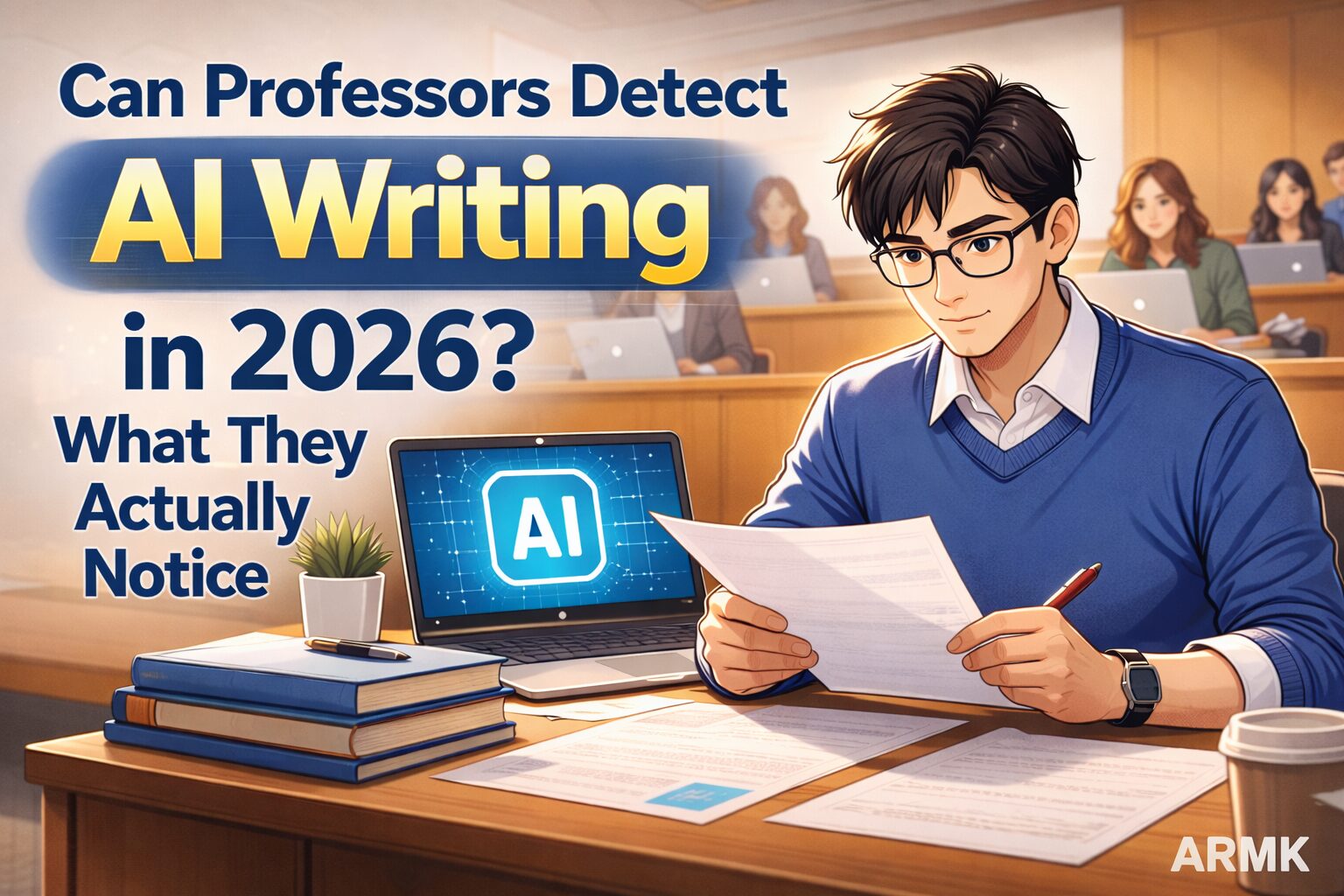
Can professors detect AI writing?
With tools like ChatGPT becoming common in academic work, many students wonder whether instructors can identify AI-generated content — even without using detection software.
The short answer:
Sometimes, yes.
But not in the way many people assume.
In 2026, detection is rarely about a “magic tool.” It’s often about pattern recognition, writing consistency, and academic context.
This guide explains how professors actually identify AI writing — and where assumptions about detection often go wrong.
Table of Contents
Do Professors Always Use AI Detection Software?
Not always.
Some universities integrate systems like Turnitin into their submission process. Others leave AI detection optional.
However, even when software is available, instructors often rely on their own judgment first.
Professors are trained to evaluate:
- Writing style consistency
- Argument development
- Depth of analysis
- Citation quality
- Logical flow
AI detection tools support review.
They do not replace instructor observation.
For a breakdown of institutional workflow, see our guide on Do Universities Use AI Detectors in 2026?
How Professors Identify AI Writing Without Software
Here are the most common signals instructors notice:
1️⃣ Sudden Writing Style Change
If a student’s previous assignments show:
- Basic grammar
- Limited vocabulary
- Simple sentence structure
And a new submission suddenly includes:
- Highly polished academic tone
- Advanced transitions
- Complex but generic phrasing
That inconsistency can raise suspicion.
Professors compare patterns over time.
2️⃣ Overly Generic but “Perfect” Structure
AI writing often:
- Sounds confident
- Avoids strong personal insight
- Uses balanced but shallow arguments
- Repeats structured phrasing patterns
Human writing tends to show:
- Imperfections
- Personal voice
- Specific references to class discussions
Perfect structure can sometimes look artificial.
3️⃣ Lack of Course-Specific Depth
Professors look for:
- References to lectures
- Specific terminology used in class
- Unique examples discussed during sessions
AI-generated content may miss these nuances unless heavily edited.
4️⃣ Inability to Defend the Work
In some cases, instructors may:
- Ask follow-up questions
- Request clarification
- Conduct oral explanation sessions
If a student struggles to explain arguments clearly, that can influence review decisions.
Can Professors Detect AI 100% Accurately?
No.
Human judgment is not perfect.
False assumptions can occur.
That’s why many institutions combine:
- Instructor review
- AI detection tools
- Draft history checks
- Academic integrity procedures
For a deeper look at detection reliability, read:
AI Detection Accuracy in 2026
Do Professors Check Writing History?
Increasingly, yes.
Platforms like Google Docs allow instructors to:
- Review revision history
- See writing progression
- Identify copy-paste behavior
A fully generated document pasted instantly appears differently from a gradually developed draft.
Writing process visibility matters.
When Suspicion Escalates
Professors typically escalate only when:
- Writing style shifts dramatically
- AI probability reports are high
- Student explanation is inconsistent
- Academic integrity policies require review
Escalation often involves:
- Department review
- Integrity committees
- Student clarification opportunity
Detection is procedural — not automatic punishment.
If you’re concerned about false flags, see:
Can AI Detectors Be Wrong?
Are Professors Better Than AI Tools at Detecting AI?
Not necessarily.
But they notice context better.
AI tools analyze patterns statistically.
Professors analyze:
- Consistency
- Course alignment
- Argument depth
- Academic behavior
The two approaches often complement each other.
What Reduces Suspicion Naturally?
Instead of trying to “beat detection,” safer academic practices include:
- Using AI for brainstorming, not final drafts
- Rewriting fully in your own voice
- Adding class-specific references
- Maintaining consistent writing style
- Understanding your arguments deeply
Responsible usage reduces risk more reliably than manipulation tactics.
Final Reality
Can professors detect AI writing?
Sometimes — especially when inconsistencies appear.
But detection is rarely based on a single factor.
It is usually a combination of:
- Pattern recognition
- Context evaluation
- Process review
- Institutional policy
AI detection in 2026 is not about “catching” students instantly.
It is about maintaining academic standards in evolving environments.
Even when AI content is rewritten, predictable structural consistency may still be noticeable.
At AI Tools Guide, we don’t hype tools — we analyze how AI actually works in real academic systems.
FAQs
1. Can professors tell if you used ChatGPT?
Sometimes. Professors may notice writing style changes, generic structure, or lack of course-specific references. They may also use AI detection tools as support.
2. Do professors check for AI without software?
Yes. Instructors often rely on writing consistency, draft history, and academic context before using software.
3. Can professors detect AI if you edit it?
Heavy editing can reduce obvious patterns, but inconsistencies in voice or argument depth may still raise suspicion.
4. Do all professors use AI detection tools?
No. Usage depends on institutional policy and instructor discretion.