Creating high-quality content doesn’t begin with writing—it begins with research.
Whether you’re publishing a blog post, recording a YouTube video, creating a LinkedIn article, or designing a Pinterest infographic, the quality of your content depends on the quality of the information you collect.
Many creators make the same mistake: they open ChatGPT, ask one question, copy the answer, and start writing.
While AI can save hours of research time, treating AI as the only source often leads to outdated information, missing context, or factual inaccuracies. That’s why experienced creators use AI as a research assistant—not as the final authority.
A structured AI research workflow helps you combine the speed of AI with search intent analysis, trusted sources, and fact verification. The result is content that is not only faster to create but also more accurate, reliable, and useful for your audience.
In this guide, you’ll learn the practical AI research workflow our team recommends for bloggers, YouTubers, freelancers, marketers, and other content creators who want to research smarter before they create.
Table of Contents
Quick Answer
An AI research workflow is a structured process that helps content creators research topics faster while improving accuracy. Instead of relying on a single AI response, an effective workflow combines search intent analysis, Google SERP research, AI tools, fact verification, organized notes, and outline creation before writing. This approach reduces AI hallucinations and helps you create more trustworthy blog posts, YouTube videos, and other digital content.
Workflow at a Glance
- ⏱️ Estimated setup: 15–30 minutes
- 🎯 Difficulty: Beginner to Intermediate
- 👥 Best for: Bloggers, YouTubers, SEO writers, marketers, freelancers
- 📄 Output: Verified research notes and a ready-to-write content outline
Why AI Research Matters for Content Creators
Publishing content consistently is no longer the biggest challenge.
Publishing accurate, trustworthy, and helpful content is.
Modern AI tools can generate ideas, summarize information, explain complex topics, and organize research in minutes. However, they can also produce incorrect facts, omit important context, or confidently present inaccurate information if their outputs aren’t verified.
A repeatable research workflow helps you:
- Find relevant information faster.
- Understand what users are actually searching for.
- Compare insights from multiple AI tools.
- Verify important claims using trusted sources.
- Organize research before writing.
- Reduce the risk of AI hallucinations.
- Build higher-quality content that readers can trust.
Rather than replacing your judgment, AI becomes a productivity partner that supports better research and better decisions.
Who Should Use This AI Research Workflow?
This workflow is designed for anyone who creates online content and wants to improve the quality of their research.
It is especially useful for:
- Bloggers and niche website owners
- YouTubers and video creators
- Affiliate marketers
- SEO content writers
- Freelancers
- Digital marketers
- Small business owners
- Beginners learning AI-assisted content creation
If your goal is to create better content—not academic research papers—this workflow is built for you.
Note: If you’re researching for academic writing, literature reviews, or research papers, we’ve published dedicated guides covering those topics separately.
What You’ll Build by Following This Workflow
By following this AI research workflow, you’ll create a repeatable system that helps you research content more efficiently while improving accuracy and confidence.
Instead of relying on a single AI response, you’ll be able to:
- Define clear research goals before gathering information.
- Understand search intent to match what people are actually looking for.
- Collect insights using AI tools alongside Google Search.
- Verify important facts using trusted sources before publishing.
- Organize your research into structured notes instead of scattered browser tabs.
- Build a clear content outline that makes writing faster and more focused.
- Reduce the risk of AI hallucinations and unsupported claims.
- Reuse the same research process for blog posts, YouTube videos, newsletters, LinkedIn posts, and other content formats.
By the end of this guide, you’ll have a practical research system that you can repeat for every future content project—not just a collection of AI tools or prompts.
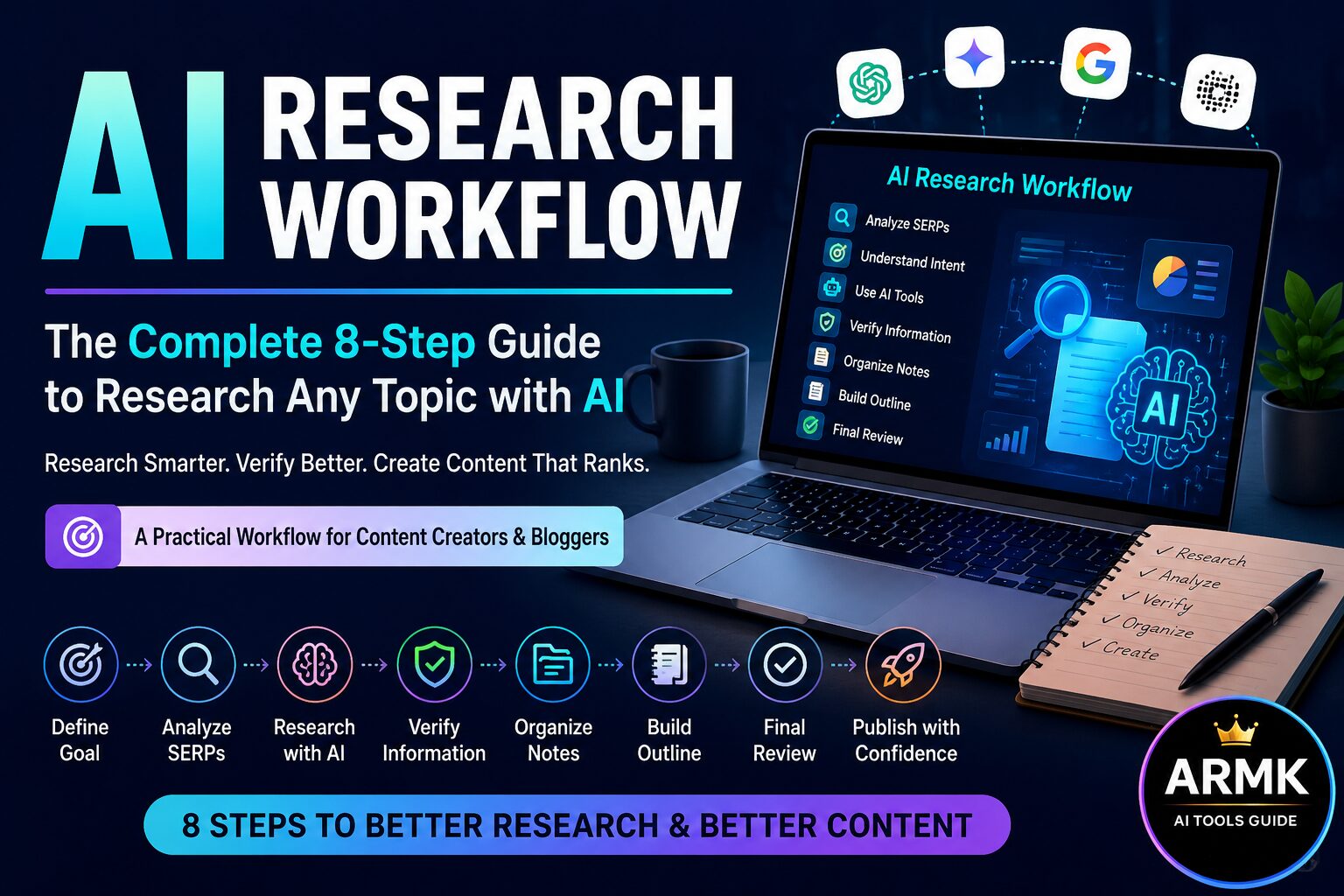
The 8-Step AI Research Workflow
Good research isn’t about collecting the most information.
It’s about collecting the right information, verifying it, and organizing it into a structure that’s easy to turn into high-quality content.
The workflow below is designed to help you do exactly that.
Step 1: Define Your Research Goal
Before opening ChatGPT, Perplexity, or Google Search, take a moment to define exactly what you want to research.
A clear research goal helps you avoid collecting irrelevant information and keeps your research focused.
For example, instead of searching:
“ChatGPT”
define a specific goal such as:
“Understand how beginners can use ChatGPT for content creation in 2026.”
The more specific your goal, the easier it becomes to ask better questions and evaluate the information you find.
Why This Matters
Without a clear objective, it’s easy to collect dozens of unrelated sources that don’t help you answer your audience’s questions.
A focused goal saves time and improves the quality of every step that follows.
Practical Tip
Write your research goal in one sentence before opening any AI tool.
If you can’t explain what you’re trying to learn in one sentence, your topic is probably still too broad.
Recommended Tools
- ChatGPT (refining research questions)
- Google Docs or Notion (recording your research goal)
Step 2: Understand Search Intent
Once you’ve defined your research goal, the next step is understanding why people search for that topic.
Different users can search the same keyword with completely different expectations.
For example:
Someone searching for:
“ChatGPT workflow”
might be looking for:
- a beginner guide
- a productivity workflow
- prompt templates
- business automation
- content creation tips
Understanding these expectations helps you create content that matches what readers actually want.
Why This Matters
Even well-written content can struggle to perform if it doesn’t satisfy search intent.
Researching intent before writing reduces the risk of creating content that answers the wrong question.
Practical Tip
Review the first page of Google and note:
- common headlines
- recurring subtopics
- frequently asked questions
- content formats
Patterns usually reveal the dominant search intent.
Recommended Tools
- Google Search
- Google Autocomplete
- People Also Ask
- Related Searches
Step 3: Analyze Google SERPs
Before relying on AI, study the current search results.
Google’s first page often reveals what users expect and what type of content performs well.
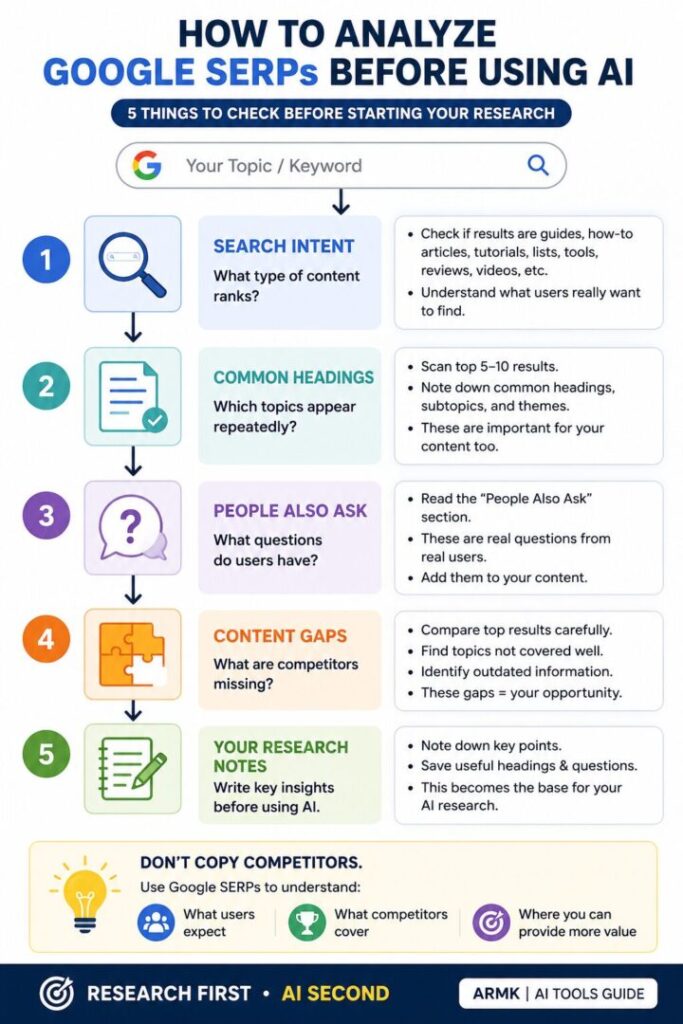
Look for:
- recurring headings
- common questions
- missing information
- content gaps
- freshness of articles
Your goal isn’t to copy competitors.
It’s to understand the landscape and identify opportunities to provide something more useful.
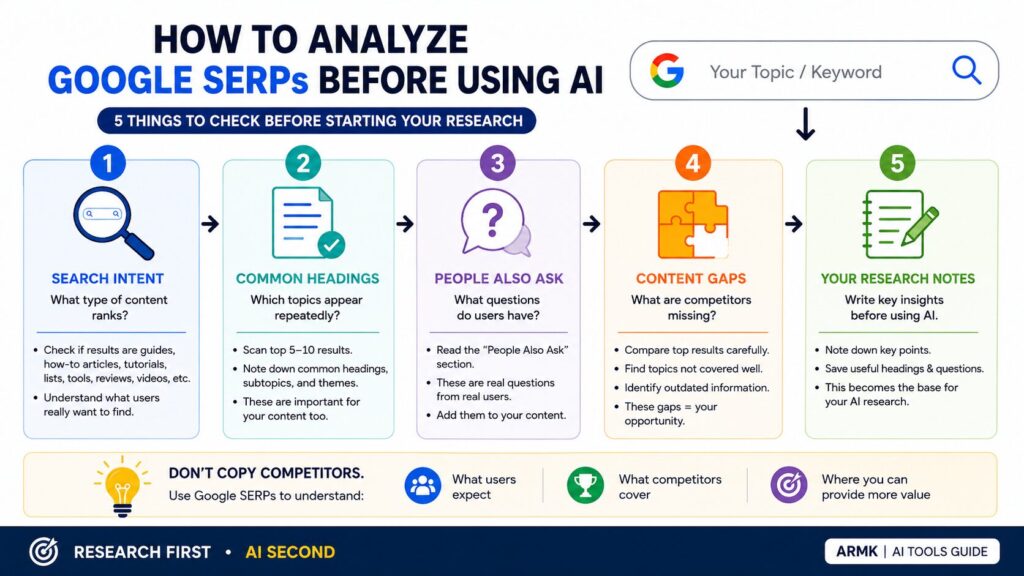
Learn how to analyze Google search results before using AI for research. This infographic explains the five essential SERP analysis steps every content creator should follow.
Why This Matters
SERP analysis helps you create content that’s both relevant and differentiated.
Practical Tip
Instead of reading every article, compare the top five results and identify:
- what all of them cover
- what none of them explain well
Those gaps often become your strongest sections.
Recommended Tools
- Google Search
- Incognito Mode
- SEO browser extensions (optional)
Step 4: Research Smarter with AI
Now you have three valuable inputs:
✅ Your research goal
✅ Search intent
✅ Google SERP insights
Instead of asking ChatGPT a generic question, use everything you’ve collected to give AI proper context.
For example, suppose you’ve completed the previous steps.
You now know:
Research Goal
Help beginners learn ChatGPT for content creation.
Search Intent
Users want a beginner-friendly, practical workflow with real examples.
Google SERP Insights
Most articles explain ChatGPT features but don’t show a repeatable workflow.
Now your AI prompt becomes much stronger.
Example Prompt
I’m writing a beginner-friendly article titled “ChatGPT Content Creation Workflow for Beginners.”
My research goal is to help beginners use ChatGPT more effectively for content creation.
Google search results mainly explain ChatGPT features but rarely provide a practical workflow.
Suggest a complete workflow with practical examples, common mistakes to avoid, and actionable tips. Avoid unsupported claims and focus on helping content creators.
Notice the difference.
Instead of asking:
“Tell me about ChatGPT.”
you’re asking AI a focused research question based on everything you’ve already learned.
Why This Matters
AI gives better answers when it understands:
- your objective
- your audience
- search intent
- competitor gaps
The quality of your research often depends more on your prompt than on the AI model itself.
Practical Tip
Never start AI research with a blank prompt.
First collect:
- research goal
- search intent
- SERP observations
Then combine them into one detailed research prompt.
Recommended AI Tools
- ChatGPT
- Perplexity
- Gemini
- Claude (optional)
If you’re new to using ChatGPT effectively, our ChatGPT Content Creation Workflow for Beginners explains how to structure prompts, generate better drafts, and use ChatGPT more strategically throughout the content creation process.
Step 5: Verify Information with Trusted Sources
AI can speed up research, but it can also generate outdated, incomplete, or incorrect information. Before using any AI-generated content, verify important facts using authoritative sources.
How to Do It
Check important claims against trusted sources such as:
- Official company websites
- Government websites (.gov)
- Educational institutions (.edu)
- Original research papers
- Product documentation
- Reputable industry publications
Verify information such as:
- Statistics and data
- Product features
- Pricing
- Release dates
- Research findings
- Quotes and references
Practical Tip
If you can’t confirm a claim from a reliable source, don’t include it in your article.
Recommended Sources
- Official websites
- Google Search
- Google Scholar (when appropriate)
- Product documentation
- Government and educational websites
Step 6: Organize Your Research Notes
Once your research is verified, organize everything before you begin writing.
Instead of keeping random notes across different tabs, group similar ideas together so your article follows a logical structure.
Organize Notes into Categories
- Key facts
- Important statistics
- Examples
- Expert insights
- Frequently asked questions
- Supporting resources
A simple document, Notion page, or Google Docs file is enough for most projects.
Practical Tip
Separate verified facts from your own ideas. This makes writing faster and reduces the chance of mixing opinions with factual information.
Recommended Tools
- Notion
- Google Docs
- Obsidian
- Microsoft OneNote
Step 7: Build a Structured Outline
Now convert your research into a clear outline.
Don’t ask AI to write the article immediately.
Instead, create the structure first.
A strong outline helps ensure your content covers the right topics in the right order.
Example Outline
- Introduction
- Quick Answer
- Step-by-Step Guide
- Practical Example
- Common Mistakes
- FAQs
- Final Checklist
- Conclusion
Practical Tip
Compare your outline with the top-ranking pages from Step 3. If an important topic is missing, add it before you start writing.
Recommended AI Tools
- ChatGPT
- Claude
- Gemini
Step 8: Perform a Final Research Review
Before writing your first paragraph, spend a few minutes reviewing your research.
Ask yourself:
- Is every important claim verified?
- Have I answered the user’s search intent?
- Am I adding value instead of repeating competitors?
- Is my outline complete?
- Are my examples accurate and practical?
If the answer is yes, you’re ready to move from research to writing.
Final Research Checklist
- ✅ Search intent understood
- ✅ Google SERPs analyzed
- ✅ AI research completed
- ✅ Important facts verified
- ✅ Notes organized
- ✅ Outline finalized
- ✅ Ready to write
Common AI Research Mistakes to Avoid
Understanding the workflow is important.
Following it consistently is what helps you create more accurate and trustworthy content.
Here are some of the most common mistakes content creators make when using AI for research.
Mistake #1: Starting AI Research Without a Clear Goal
Many beginners open ChatGPT or another AI tool and immediately ask broad questions like:
“Tell me about SEO.”
Broad prompts often produce broad answers.
Instead, define your research goal first.
For example:
“Understand how beginners can use AI for keyword research in 2026.”
A clear objective leads to more focused research and better follow-up questions.
Mistake #2: Skipping Google SERP Analysis
AI can summarize information, but it doesn’t automatically show what users expect from a search query.
Before asking AI, spend a few minutes reviewing:
- Search intent
- Top-ranking pages
- People Also Ask questions
- Related searches
- Content gaps
This helps you research topics that align with real user needs instead of assumptions.
Mistake #3: Trusting the First AI Response
AI responses are a starting point—not the final answer.
Different AI tools may explain the same topic differently, and important details can sometimes be missing or inaccurate.
Whenever a claim matters, compare it with reliable sources before including it in your content.
Mistake #4: Never Verifying Important Information
Statistics, product features, release dates, pricing, and technical details can change over time.
Before publishing, verify important information using trusted sources such as:
- Official websites
- Product documentation
- Government or educational websites
- Reputable industry publications
Verification is one of the simplest ways to improve the credibility of your content.
Mistake #5: Collecting Too Much Information
More research isn’t always better research.
Saving dozens of articles, screenshots, and AI responses without organizing them often leads to confusion.
Instead, collect only the information that supports your research goal and organize it into clear categories before writing.
Mistake #6: Writing Before Organizing Your Notes
Many creators jump from research directly into drafting.
A few minutes spent organizing notes and creating an outline can make writing faster, more structured, and easier to follow.
Think of your outline as the bridge between research and content creation.
AI Research Checklist
Before you start writing, review this checklist to make sure your research is complete.
☐ Research goal clearly defined
☐ Search intent understood
☐ Google SERPs analyzed
☐ People Also Ask questions reviewed
☐ Content gaps identified
☐ AI research completed using appropriate tools
☐ Important facts verified from trusted sources
☐ Research notes organized
☐ Content outline created
☐ Final research review completed
Following the same checklist for every project helps create a consistent research process and reduces the chances of missing important information before you begin writing.
📥 Download Free AI Workflow Resources
Want to reuse this workflow for future projects?
Download these free resources to make your research process faster and more organized.
Available Resources
- 📄 Printable AI Research Checklist (PDF) — A print-friendly checklist you can use before writing any article or script.
- 📊 AI Research Tracker (Google Sheets) — Organize research goals, sources, notes, and progress in one place.
- 🖼️ AI Research Checklist (PNG) — A quick visual reference for your desktop or mobile device.
- 📝 AI Research Workspace (Notion) (Coming Soon) — Manage your research workflow with reusable templates and checklists.
These resources are designed to help you follow the same structured process every time you research a new topic.
Frequently Asked Questions
1. What is an AI research workflow?
An AI research workflow is a structured process that combines AI tools, Google Search, search intent analysis, trusted sources, and organized research notes to help create accurate and reliable content. Instead of relying on a single AI response, it follows a repeatable system before writing begins.
2. Which AI tool is best for content research?
There isn’t one best AI tool for every task.
Many content creators use a combination of tools depending on their needs. For example:
ChatGPT for brainstorming and explanations
Perplexity for web-backed research and citations
Gemini for alternative perspectives
Google Search for understanding search intent and current search results
Using multiple sources generally produces more balanced research than depending on a single tool.
3. Can AI replace Google Search for research?
No.
AI and Google Search serve different purposes.
AI helps summarize information, generate ideas, and organize research, while Google Search helps you discover current information, understand search intent, and access authoritative sources for verification.
For most content projects, using both together is more effective than relying on either one alone.
4. How do I verify AI-generated information?
Compare important claims with reliable sources such as official websites, product documentation, government resources, educational institutions, or reputable industry publications.
Whenever accuracy matters, avoid relying solely on AI-generated responses.
5. Is this workflow suitable for beginners?
Yes.
This workflow is designed for beginners as well as experienced creators. The step-by-step process helps you build good research habits from the beginning, making it easier to create accurate and well-structured content over time.
6. Can I use this workflow for YouTube videos and newsletters?
Absolutely.
Although the examples in this guide focus on content research, the same workflow can be used before creating YouTube videos, newsletters, LinkedIn posts, podcasts, and other forms of digital content.
The research process remains largely the same—the final content format is what changes.
Final Recommendation
AI can dramatically reduce the time spent researching a topic, but speed alone doesn’t create valuable content.
The strongest content usually comes from combining AI with human judgment, search intent analysis, fact verification, and organized research.
Instead of treating AI as a replacement for research, use it as a tool that helps you ask better questions, compare information, and build a reliable foundation before writing.
Following a structured AI research workflow won’t guarantee that every article ranks well, but it can help you produce content that is more accurate, more organized, and more useful for your audience.