Introduction
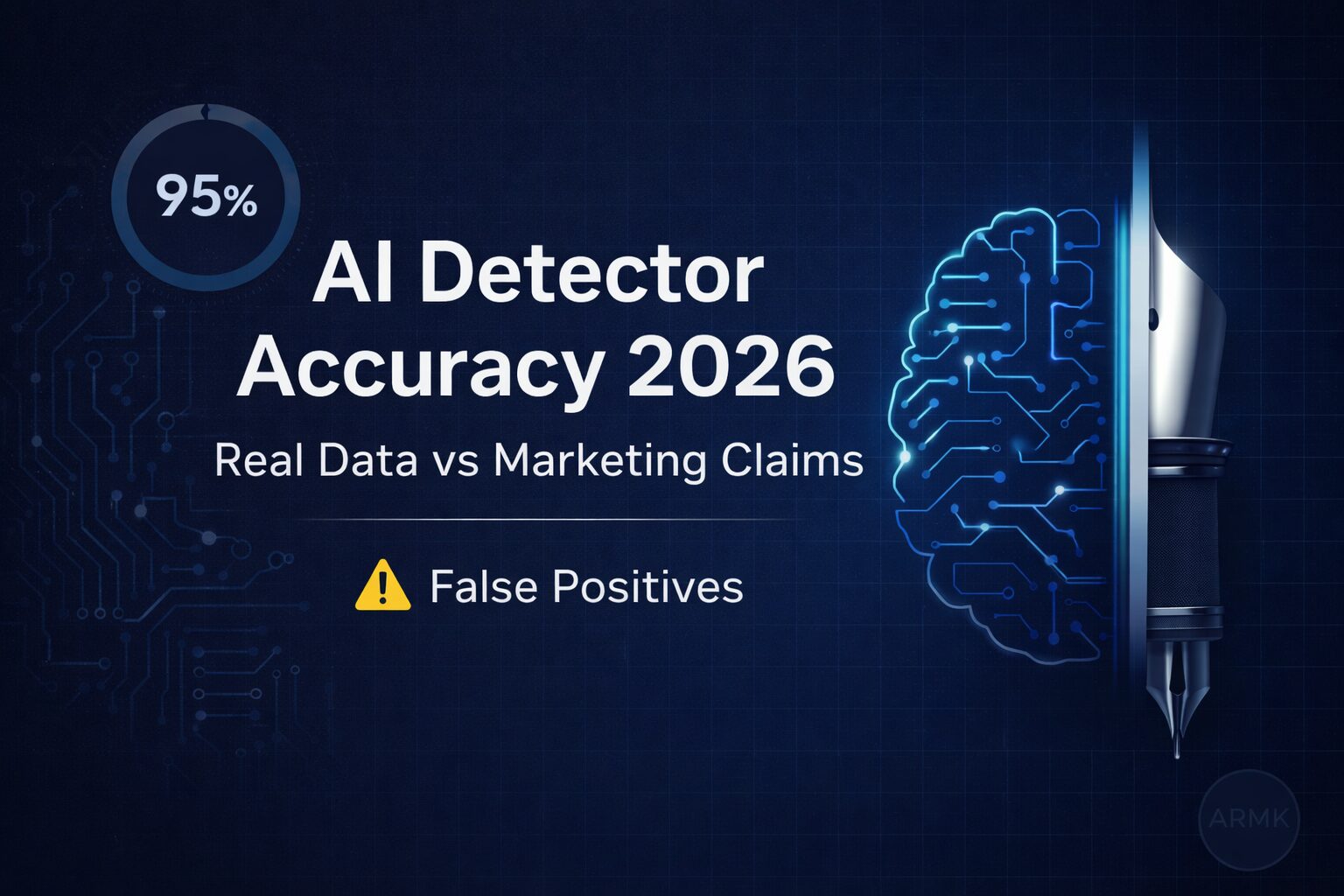
AI detectors claim accuracy rates as high as 90–95%.
But in real classrooms, real essays, and real mixed human-AI writing, those numbers don’t always hold.
So how accurate are AI detectors in 2026 — outside marketing pages?
The answer depends on context, editing level, text length, and model evolution.
AI detection systems rely on probability modeling — not certainty. And once human revision enters the workflow, reliability shifts.
In this guide, we analyze reported accuracy claims, false positive risks, independent research discussions, and why AI detection can never reach 100% certainty.
Let’s separate controlled test results from real-world reliability.
Table of Contents
What Do AI Detection Tools Claim About Accuracy?
Most commercial AI detectors promote:
- High accuracy on fully AI-generated content
- Strong performance on longer text samples
- Probability-based AI scoring systems
However:
- There is no universal testing benchmark
- No independent global certification standard
- No standardized cross-tool evaluation
Each platform defines and measures “accuracy” differently.
Some test on controlled datasets.
Others evaluate against older AI model outputs.
Few disclose full testing methodology publicly.
That distinction matters.
Because without standardized benchmarking, percentage claims alone can be misleading.
Reported Accuracy Rates from Major AI Detectors (2026)
Different platforms communicate accuracy differently. Some publish estimated rates, others avoid specific percentages.
Here’s how positioning generally looks in 2026:
| Tool | Public Accuracy Positioning | Important Context |
|---|---|---|
| Turnitin | Institutional probability indicator | Does not publicly publish standardized % accuracy |
| GPTZero | Strong detection on unedited AI text | Accuracy drops with heavy editing |
| Originality.ai | High accuracy marketing claims | Testing methodology not fully standardized publicly |
| Copyleaks | Multi-model detection approach | Performance varies by content type |
Important:
- No universal benchmarking body verifies these numbers.
- Tools test under different conditions.
- Real-world classroom writing is rarely “pure AI” or “pure human.”
Accuracy claims are scenario-dependent — not universal truths.
Why Accuracy Percentages Can Be Misleading
When a platform states:
“95% accurate”
It usually means:
- Correct classification under controlled testing
- Specific dataset conditions
- Limited editing scenarios
It does not mean:
- 95% accuracy across all universities
- 95% reliability on mixed human-AI writing
- 95% certainty after heavy rewriting
Real-world writing is not controlled.
Students revise. Writers paraphrase. AI drafts get edited.
Accuracy in laboratory conditions does not equal reliability in live academic use.
False Positives and False Negatives: The Real Risk
AI detection errors fall into two types:
False Positive
Human-written text flagged as AI-generated.
False Negative
AI-generated text not detected.
False positives are particularly controversial in academic settings. A high AI score may trigger review — even if the student wrote the content independently.
Research discussions suggest flags are more likely when:
- Writing tone is highly formal
- Structure is predictable
- Grammar is consistently polished
- Technical or scientific language is used
Detection systems analyze writing probability patterns — not author intent.
While vendors rarely publish exact false positive rates, independent discussions suggest that structured academic writing increases misclassification risk.
If you want a deeper breakdown of how these pattern systems operate, read our technical guide on how AI detectors work.
And if you’re specifically concerned about being wrongly flagged, see our detailed guide on what students should do after a false AI detection flag.
What Academic Research Suggests About AI Detection Reliability
Independent research and institutional reviews indicate:
- Accuracy drops significantly when AI text is edited
- Mixed human-AI writing reduces detection consistency
- Short text samples are harder to classify reliably
- Newer AI models reduce obvious pattern differences
Most universities treat AI detection scores as indicators — not automatic evidence.
Instructors often review:
- Draft progression
- Writing style consistency
- Citation integration
- Context of submission
AI tools provide signals. Humans interpret them.
No large-scale global benchmarking study currently standardizes AI detector accuracy across platforms.
How Accurate Are AI Detectors in 2026?
Accuracy varies significantly by scenario.
More reliable when:
- Content is fully AI-generated
- Text is long and unedited
Less reliable when:
- Human editing is involved
- AI and human writing are blended
- Creative or academic structure is strong
AI detectors in 2026 are more advanced than early versions — but they still rely on statistical modeling.
They estimate likelihood — not authorship certainty.
There is currently no AI detection system that guarantees 100% perfect accuracy across all real-world use cases.
Editing AI-generated text can influence detection scores — but it does not automatically remove statistical patterns.
Why AI Detection Accuracy Will Never Reach 100%
Even with improvements in 2026, perfect detection is structurally impossible.
Here’s why:
- AI models evolve faster than detection systems
- Human-AI mixed writing creates blended patterns
- No universal “authorship fingerprint” exists
- Writing style varies naturally between individuals
Detection tools look for statistical irregularities — not hidden digital signatures.
As AI writing becomes more human-like, detection becomes a probability judgment rather than a binary classification.
This is not a temporary limitation.
It is a structural limitation.
Students often rely on free tools — but not all are equal. Here’s our comparison of the best free AI detector tools available.
What Most “AI Detector Accuracy” Claims Don’t Tell You
Some platforms highlight peak test performance but rarely emphasize edge cases:
- Edited AI drafts
- Multilingual writers
- Highly technical academic tone
- Short-form submissions
Real reliability depends more on writing context than advertised percentage rates.
Accuracy claims are rarely independently verified.
Percentage scores differ across tools.
One detector may label the same text 82% AI. Another may label it 47% AI.
There is no universal scoring framework.
AI models evolve continuously. Detection systems adapt in response.
This creates an ongoing catch-up cycle — not a fixed reliability benchmark.
Should Institutions Fully Trust AI Detection Scores?
Most academic institutions do not rely solely on AI detection reports.
They are typically:
- Used as screening indicators
- Reviewed manually
- Combined with policy evaluation
An AI score alone does not equal academic misconduct.
Understanding this reduces unnecessary fear and promotes responsible AI use instead of avoidance tactics.
Final Assessment: Are AI Detection Systems Truly Reliable?
AI detection tools in 2026 are improving — but they remain probabilistic systems.
They can:
✔ Identify heavily AI-generated content
✔ Assist institutions in maintaining standards
They cannot:
✘ Provide guaranteed proof
✘ Replace instructor judgment
✘ Operate under a standardized global benchmark
Reliability depends on context, editing level, and writing complexity.
At AI Tools Guide, we don’t hype tools — we test how AI actually works.
Understanding detection accuracy helps you interpret scores rationally — not emotionally.
Frequently Ask Questions
How accurate are AI detectors in 2026?
AI detectors generally perform well on fully AI-generated content, but accuracy decreases when text is edited or mixed with human writing. They provide probability-based estimates, not guaranteed proof.
Can AI detectors make mistakes?
Yes. AI detectors can produce false positives (human text flagged as AI) and false negatives (AI text not detected), particularly in structured academic writing.
Are AI detection accuracy percentages standardized?
No. There is no universal benchmarking authority. Each platform uses its own datasets and evaluation methods.
Do universities rely only on AI detection scores?
No. Most institutions treat AI detection reports as screening indicators that require human review.