Introduction
AI writing tools are now common in schools and universities.
Students use ChatGPT for brainstorming.
Grammarly for polishing.
QuillBot for rewriting.
But before submission, one question creates anxiety:
Is my work going to be flagged as AI-generated?
That’s why many students look for free AI detection tools.
The problem?
“Free” doesn’t always mean unlimited.
And not all detectors work the same way.
This guide breaks down:
- Which AI detectors are actually free
- What limits apply
- How accurate free versions really are
- Which tools are best for student self-checks
No hype. Just structured comparison.
Table of Contents
What “Free AI Detector” Actually Means
Before listing tools, we need clarity.
In 2026, most AI detectors follow one of these models:
1️⃣ Fully Free (Unlimited)
No payment required. Often basic detection only.
2️⃣ Freemium (Limited Words)
Free up to a word count per month.
3️⃣ Free Trial
Short-term access before payment required.
4️⃣ Free Tool with Hidden Upsell
Shows partial results unless upgraded.
If you don’t understand this difference, you’ll feel misled.
Now let’s compare actual options students can use.
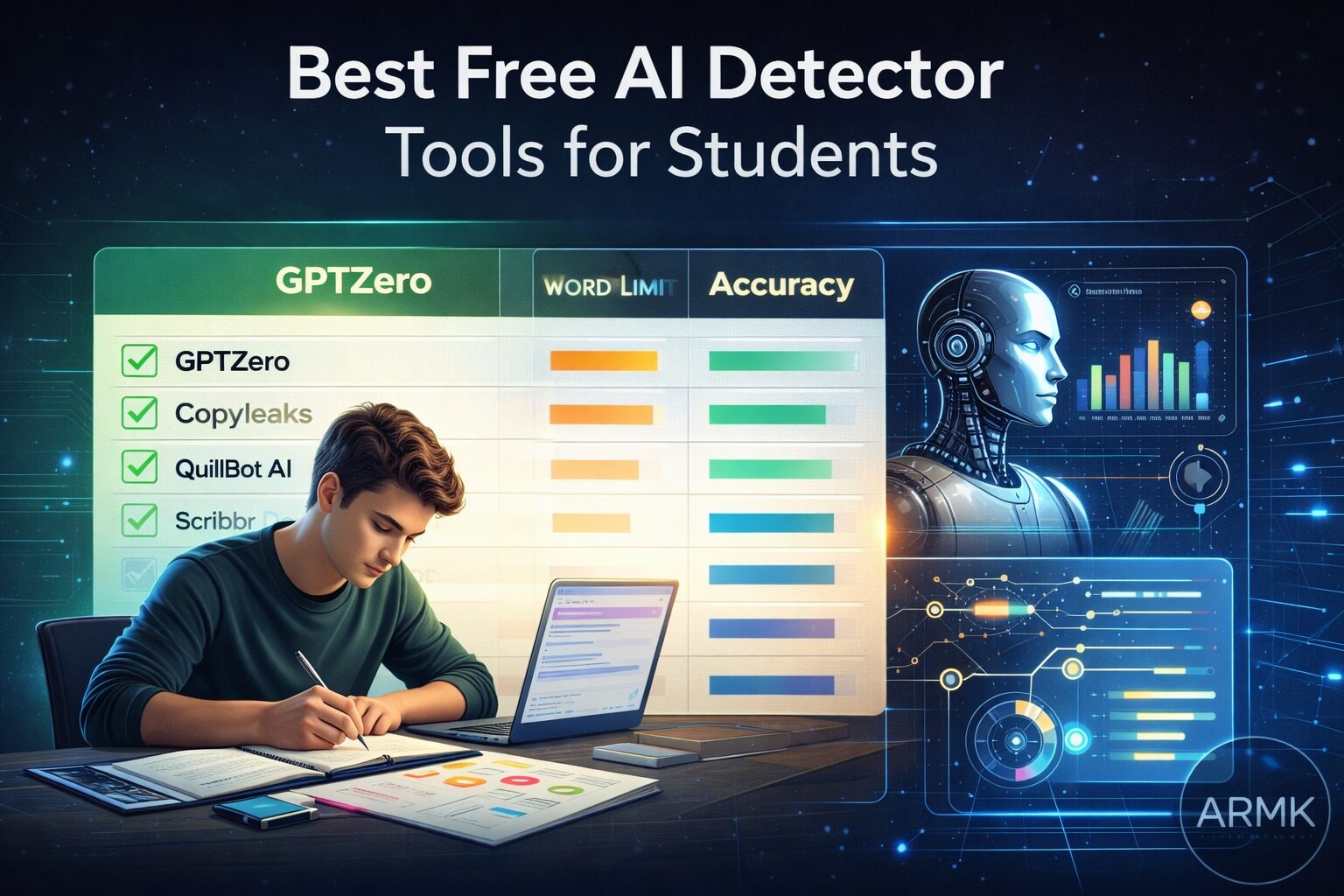
Quick Comparison Table
| Tool | Free Limit | Plagiarism Included? | Best For | Limitations |
|---|---|---|---|---|
| GPTZero | Limited free checks | No | Standalone AI probability check | Word limits |
| Copyleaks | Limited free credits | Yes (partial) | Combined AI + plagiarism | Requires sign-up |
| QuillBot AI Detector | Free web access | No | Quick AI probability scan | No plagiarism |
| Scribbr AI Detector | Free preview | Yes (via paid plans) | Academic style checking | Limited full reports |
| Grammarly AI Detector | Free basic check | No | Surface-level AI probability | Minimal transparency |
Now let’s analyze them individually.
1️⃣ GPTZero (Free Plan)
What It Offers
- Free limited AI checks
- AI probability percentage
- Sentence-level highlighting
- Clear AI likelihood output
Strengths
- Transparent scoring
- Designed specifically for AI detection
- Easy to use
Weaknesses
- Word count limits on free plan
- No integrated plagiarism detection
- Accuracy varies with heavily edited content
Best For Students Who:
- Want a quick self-check before submission
- Need probability-based AI scoring
- Don’t need plagiarism comparison
2️⃣ Copyleaks (Free Credits)
What It Offers
- Limited free AI detection credits
- Combined AI + plagiarism scanning
- Multi-language support
Strengths
- Institutional-level detection model
- Broader scanning capability
- Academic-friendly interface
Weaknesses
- Requires account creation
- Free access is limited
- Full functionality behind paywall
Best For Students Who:
- Want both AI + plagiarism detection
- Need more structured reporting
- Are testing institutional-style tools
3️⃣ QuillBot AI Detector
QuillBot is widely known for paraphrasing — but it also offers AI detection.
What It Offers
- Free AI detection access
- Simple probability scoring
- Web-based use
Strengths
- Easy access
- No heavy setup
- Works well for quick checks
Weaknesses
- No plagiarism detection
- Limited reporting depth
- Not institution-integrated
Best For Students Who:
- Want a quick, surface-level AI scan
- Already use QuillBot tools
4️⃣ Scribbr AI Detector
Scribbr focuses heavily on academic users.
What It Offers
- AI detection preview
- Strong academic positioning
- Integration with plagiarism services (paid)
Strengths
- Academic-focused brand
- Structured reporting
- Institutional tone
Weaknesses
- Full features require payment
- Free version limited
Best For Students Who:
- Want academic-style detection
- Care about structured academic presentation
5️⃣ Grammarly AI Detector
Grammarly introduced AI detection features within its ecosystem.
What It Offers
- Basic AI content detection
- Quick surface-level probability check
Strengths
- Trusted brand
- Simple interface
Weaknesses
- Limited transparency
- Not deeply specialized in AI detection alone
- No plagiarism integration in free AI checker
Best For Students Who:
- Already use Grammarly
- Want a quick second opinion
What to Expect from Free AI Detector Accuracy
Free AI detectors are helpful — but they operate within limits.
Most free versions analyze writing using statistical probability signals such as:
- Predictability patterns
- Sentence consistency
- Structural uniformity
- Linguistic burstiness
However, students should understand:
- These tools estimate probability — they do not prove authorship.
- Lower AI scores do not guarantee institutional approval.
- False positives are still possible.
Free plans often:
- Use lighter detection layers
- Restrict advanced reporting
- Limit contextual dataset comparison
That’s the trade-off of using a free version.
For a deeper technical analysis of AI detection reliability, see our full research breakdown on AI detection accuracy.
Which Free AI Detector Is Most Reliable?
There is no universal “most accurate” free detector.
Instead:
- GPTZero → Best for standalone AI probability transparency
- Copyleaks → Best for AI + plagiarism combination
- QuillBot → Best for quick checks
- Scribbr → Best academic tone
- Grammarly → Best convenience
Context matters more than ranking.
When Free Is Not Enough
If:
- Your university uses Turnitin
- Your assignment is high-stakes
- You’ve heavily edited AI-generated text
Then a free self-check does not guarantee institutional clearance.
Universities may use different detection systems.
See:
👉 Do Universities Use AI Detectors?
👉 GPTZero vs Turnitin
Free tools are preparation tools — not official clearance systems.
What Students Often Misunderstand
1️⃣ Lower AI score ≠ guaranteed safety
2️⃣ Editing AI text does not always remove statistical patterns
3️⃣ Different detectors give different scores
4️⃣ Institutional tools may behave differently
Understanding this reduces panic.
Final Verdict
Free AI detector tools can be useful for students — but only as preliminary self-check tools.
They help you:
- Understand probability risk
- Improve clarity
- Reduce obvious AI patterns
They do not:
- Replace instructor judgment
- Override institutional systems
- Guarantee zero detection
If you use AI responsibly and maintain original thinking, detection risk naturally decreases.
At AI Tools Guide, we don’t hype tools — we test how AI actually works.
Free tools are useful — but understanding how detection works matters more than chasing the lowest score.
FAQs
1. Are there completely free AI detectors?
Yes, some tools offer limited free usage. However, most apply word limits or require registration.
2. Which free AI detector is best for students?
It depends on your need. GPTZero is strong for AI probability checks, while Copyleaks combines AI + plagiarism detection.
3. Are free AI detectors accurate?
They use probabilistic models and may produce false positives. They are helpful but not definitive.
4. Can free AI detectors replace Turnitin?
No. Institutional systems operate differently and may use proprietary datasets.