
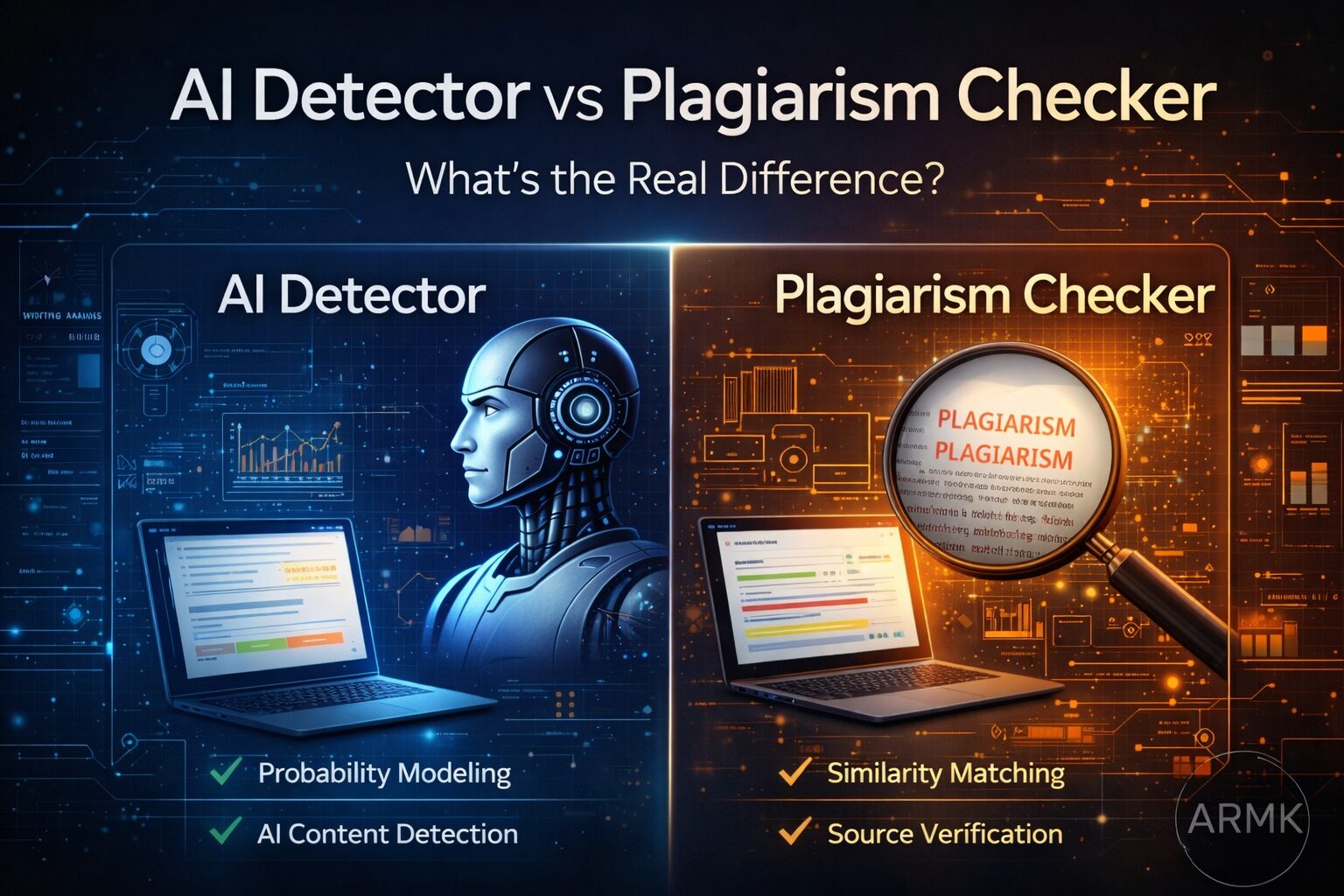
As AI writing tools become common in education and publishing, two systems are often confused:
AI detectors and plagiarism checkers.
Many students assume they are the same.
Some institutions use both.
Others integrate them into a single platform.
But technically, they serve different purposes.
This guide explains:
- What each system actually analyzes
- How they measure content differently
- When each tool is used
- Why they are not interchangeable
No marketing claims.
Just structural clarity.
Table of Contents
What Is an AI Detector?
An AI detector estimates whether text was generated by an AI system such as ChatGPT, Claude, or other large language models.
It does not search the internet for matching sources.
Instead, it analyzes statistical patterns in writing.
If you want a deeper technical explanation of how these probability models work, see our detailed guide on How AI Detectors Work.
Common signals analyzed:
- Sentence predictability
- Burstiness (variation in sentence length)
- Structural uniformity
- Probability modeling
The output is usually a probability score — not proof of authorship.
AI detection answers this question:
Does this writing statistically resemble AI-generated content?
It does not answer:
Where was this content copied from?
That is a different function entirely.
What Is a Plagiarism Checker?
A plagiarism checker compares submitted text against:
- Online sources
- Academic databases
- Published materials
- Previously submitted documents
It searches for matching sequences of words and phrases.
We’ve also explained how plagiarism databases differ from AI probability systems in our breakdown of AI Detection Accuracy and False Positives.
The result is a similarity report.
It answers:
Does this text match existing published or submitted content?
It does not determine whether text was written by a human or AI.
Plagiarism detection focuses on duplication — not authorship modeling.
Core Technical Difference
Here is the simplest explanation:
| AI Detector | Plagiarism Checker |
|---|---|
| Analyzes writing patterns | Compares text against databases |
| Uses probability modeling | Uses similarity matching |
| Estimates AI likelihood | Identifies copied content |
| Does not require source match | Requires source match |
One looks at style patterns.
The other looks at content overlap.
Can a Plagiarism Checker Detect AI?
Short answer: No.
If AI-generated content is original and not copied from a source, a plagiarism checker may show 0% similarity.
That does not mean it is human-written.
It only means it was not copied.
This is a common misunderstanding.
Students often assume a 0% similarity score means AI-safe, which we clarify further in Can AI Detectors Detect Edited or Humanized Content?
Can an AI Detector Detect Plagiarism?
Also no.
AI detectors do not scan academic databases for duplication.
They evaluate writing characteristics.
A fully plagiarized paragraph could still be flagged as human-written if it matches normal human writing patterns.
The systems are designed for different risks.
Why Many Institutions Use Both
Some academic platforms combine:
- Plagiarism detection
- AI probability scoring
For example, our comparison of GPTZero vs Copyleaks shows how some tools integrate AI scoring with plagiarism indexing.
This creates a layered integrity check.
For example, institutional platforms may integrate:
- Similarity index
- AI detection module
- Submission workflow
- LMS integration
This is why tools like Turnitin or Copyleaks often include both systems.
But technically, the engines remain separate.
Real-World Use Cases
When AI Detection Is Relevant
- Evaluating AI-assisted assignments
- Monitoring AI-generated submissions
- Reviewing structured academic essays
When Plagiarism Detection Is Relevant
- Checking for copied research
- Verifying citation integrity
- Comparing against published sources
They solve different academic integrity risks.
Why Confusion Happens
There are three main reasons:
- Some platforms combine both tools in one dashboard.
- Students see one “report” and assume it covers everything.
- Marketing language often blends AI and plagiarism detection together.
But similarity ≠ AI probability.
That distinction matters.
Which One Should Students Care About More?
It depends on context.
If your concern is:
- Copying existing sources → plagiarism checker is relevant.
- AI-generated assistance → AI detection may be relevant.
In many institutions, both are used.
Understanding the difference reduces unnecessary anxiety.
If you’re comparing free tools specifically for academic use, explore our curated list of Best Free AI Detector Tools for Students.
Final Assessment
AI detectors and plagiarism checkers serve different technical functions.
They are not competitors.
They are complementary systems.
One evaluates writing patterns.
The other evaluates duplication.
Confusing them leads to incorrect assumptions about academic risk.
Clarity solves that problem.
If you’re unsure how universities apply these systems in real classrooms, read our in-depth guide on Do Universities Use AI Detectors? to understand academic policy differences.
At AI Tools Guide, we don’t hype tools — we test how AI actually works.
If you’re using AI in writing, focus on clarity, originality, and authentic reasoning — not score chasing.
FAQ
1. Is AI detection the same as plagiarism detection?
No. AI detection estimates AI-likelihood; plagiarism detection measures text similarity.
2. Can Turnitin detect AI and plagiarism?
Some institutional systems combine both modules, but the underlying mechanisms differ.
3. If plagiarism score is 0%, can it still be flagged as AI?
Yes. Original AI-generated text may have no similarity but still trigger AI probability scoring.
4. Which is more accurate?
They measure different things, so accuracy depends on what you are evaluating.