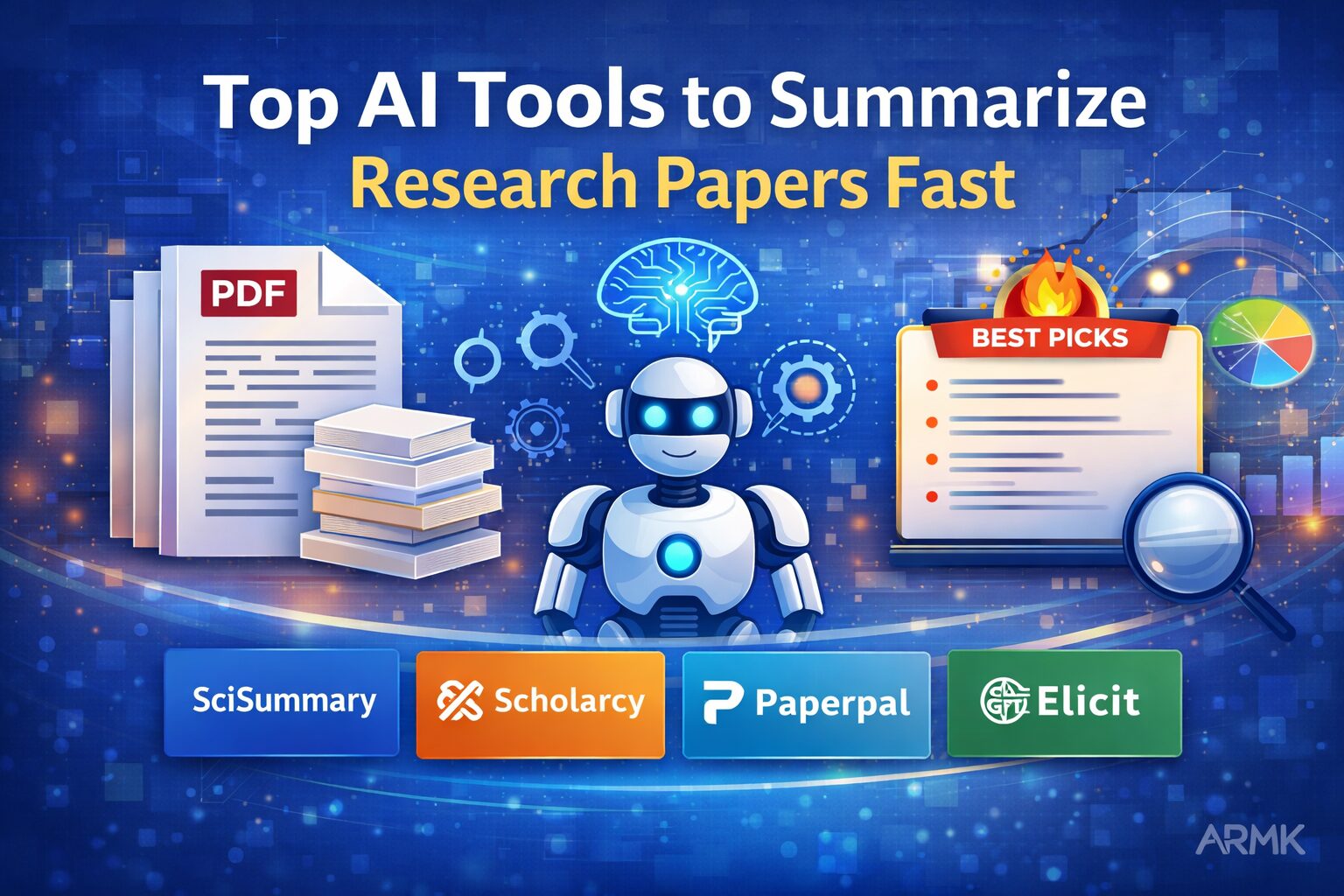
Reading research papers shouldn’t feel like decoding a puzzle.
Yet most students and researchers spend hours trying to extract key insights from dense academic content.
This is where AI tools step in.
In this guide, you’ll discover the best AI tools for summarizing research papers, how they compare, and which one actually fits your workflow—without wasting time on hype.
If you’re new to AI in research, you can also explore our complete guide on AI tools for research papers to understand how these tools fit into your academic workflow.
Table of Contents
What Are AI Tools for Summarizing Research Papers? 🤖
AI summarization tools are designed to:
- extract key findings
- simplify complex academic language
- highlight important sections
- generate structured summaries
Instead of reading entire papers, you get clear, digestible insights in minutes.
For broader research workflows, check our guide on best AI tools for literature review to discover tools beyond summarization.
🧠 Quick Comparison: Best AI Tools at a Glance
| Tool | Best For | Key Strength | Free Plan |
|---|---|---|---|
| SciSummary | Fast summaries | PDF-based summarization | Limited |
| Scholarcy | Structured insights | Flashcards & breakdown | Yes |
| Paperpal | Academic writing | Research-focused AI | Limited |
| Elicit | Research discovery | Evidence-based answers | Yes |
| ChatGPT | Flexible summarization | Custom prompts | Yes |
🏆 Top AI Tools for Summarizing Research Papers
1. SciSummary – Best for Quick PDF Summaries ⚡
Why It Stands Out:
- Upload full research papers
- Get instant summaries
- Simple and fast interface
Pros:
✔ Very fast
✔ Works directly with PDFs
Cons:
❌ Limited customization
❌ Not ideal for deep analysis
2. Scholarcy – Best for Structured Breakdown 📊
Why It Stands Out:
- Converts papers into flashcards
- Extracts key points automatically
Pros:
✔ Structured summaries
✔ Great for students
Cons:
❌ Some features behind paywall
3. Paperpal – Best for Academic Writing Support ✍️
Why It Stands Out:
- Designed specifically for researchers
- Helps with writing + summarization
Pros:
✔ Academic-focused
✔ Improves clarity
Cons:
❌ Less flexible than general AI tools
If you want to understand how to actually use these tools step by step, read our guide on how to summarize research papers using AI.
4. Elicit – Best for Research Discovery 🔍
Why It Stands Out:
- Finds relevant research papers
- Summarizes multiple sources
Pros:
✔ Strong research capability
✔ Evidence-based summaries
Cons:
❌ Learning curve
5. ChatGPT – Best for Flexible Summarization 🧠
Why It Stands Out:
- Fully customizable prompts
- Works for any type of content
Pros:
✔ Flexible
✔ Powerful prompts
Cons:
❌ Requires manual input
🧠 Which Tool Should You Choose?
👉 If you want speed → SciSummary
👉 If you want structure → Scholarcy
👉 If you want research discovery → Elicit
👉 If you want flexibility → ChatGPT
If you’re working on a full academic project, you may also need writing and editing support. Check our guide on how to write a research paper using AI.
🔗 How These Tools Fit Into Your Workflow
If you’re new to AI summarization, don’t just pick a tool blindly.
👉 First learn the workflow:
You can read our complete guide on how to summarize research papers using AI to understand prompts, steps, and best practices.
⚠️ Limitations of AI Summarization
Let’s stay real:
- AI can miss context
- Some summaries oversimplify
- Not all tools are equally accurate
👉 Always verify important research insights.
Also, be aware that AI-generated summaries may still be reviewed by detection tools. Learn how detection works in our guide on how AI detectors work in 2026.
Final Thoughts 🚀
AI tools are not here to replace research.
They’re here to make it faster, smarter, and more efficient.
If used correctly:
👉 You save time
👉 You process more information
👉 You improve productivity
If you’re concerned about originality and academic integrity, you can explore:
At AI Tools Guide, we don’t hype tools — we test how AI actually works.
If you’re a student or researcher, choose tools that fit your workflow—not just trending ones.
FAQs
1. Which AI tool is best for summarizing research papers?
It depends on your needs—speed, structure, or flexibility.
2. Are AI summaries reliable?
They are helpful, but always require verification.
3. Can AI replace reading research papers?
No, it only assists in understanding them faster.