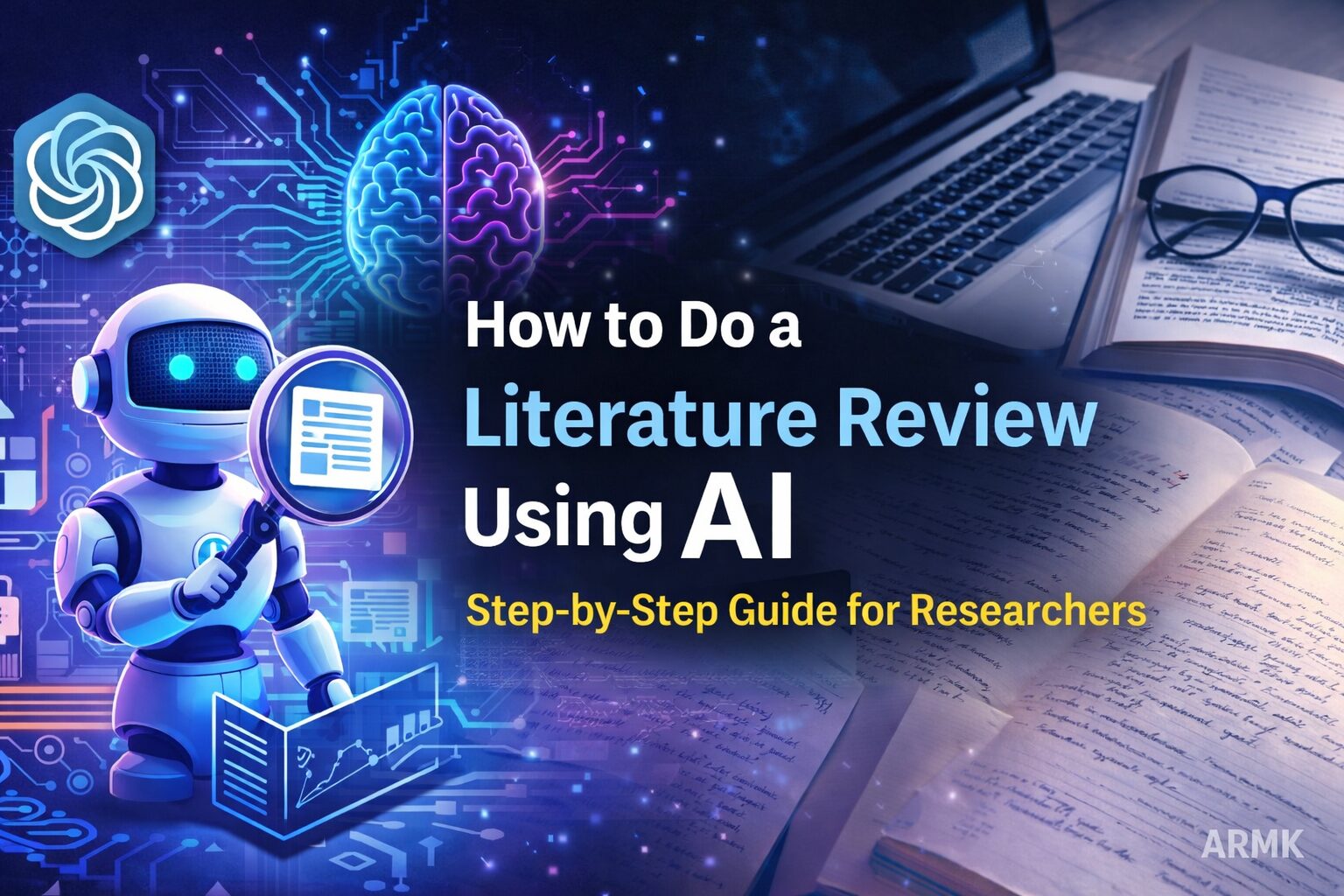
A literature review is one of the most time-consuming stages of academic research.
Researchers often need to read dozens — sometimes hundreds — of academic papers to understand the current state of research.
AI tools are now helping researchers speed up this process.
Instead of manually searching, reading, and summarizing every paper, AI can help researchers:
• discover relevant research faster
• summarize complex academic papers
• compare findings across studies
• identify potential research gaps
However, AI should assist research — not replace critical thinking.
In this guide, you will learn how to conduct a literature review using AI step by step, while maintaining academic integrity and research accuracy.
Table of Contents
What Is a Literature Review in Academic Research?
A literature review is a structured analysis of previous research related to a specific topic.
Its main purpose is to:
• summarize existing studies
• compare research findings
• identify research gaps
• build context for new research
A strong literature review does not simply list studies.
Instead, it synthesizes multiple research papers to explain the current understanding of a topic.
We have also created a detailed comparison of platforms used in academic research in our article on Best AI Tools for Academic Research.
Can AI Help With Literature Reviews?
Yes — AI can assist researchers in several stages of the literature review process.
AI tools can help with:
• discovering relevant research papers
• summarizing complex academic language
• organizing research notes
• identifying patterns across studies
However, researchers must still:
• verify AI summaries
• read original papers
• validate sources and citations
AI should be used as a research assistant, not the author of the literature review.
Step-by-Step Process to Do a Literature Review Using AI
Most literature reviews follow a structured process:
Research Question
↓
Find Relevant Research Papers
↓
Analyze Research Findings
↓
Identify Research Gaps
↓
Synthesize Research
AI tools can support researchers at each of these stages.
Step 1 – Define Your Research Topic
Before searching for papers, clearly define your research question.
AI tools like ChatGPT or Perplexity can help brainstorm research ideas.
Example prompt:
Suggest 5 research questions related to [your research topic] based on recent academic trends.
A clear research question helps narrow down relevant research papers.
Step 2 – Find Relevant Research Papers
The next step is discovering high-quality research papers.
Researchers commonly use tools such as:
• Elicit
• ResearchRabbit
• Google Scholar
• SciSpace
These tools help researchers:
• search academic databases
• discover related studies
• track citation networks
For a detailed overview of research discovery tools, see our guide on AI Tools for Research Papers.
Step 3 – Understand Complex Research Papers
Academic papers often contain technical terminology and complex methodologies.
AI tools can help explain difficult sections of research papers.
Researchers often use:
• SciSpace
• ChatGPT
• Perplexity AI
These tools can explain:
• research methodology
• statistical results
• key findings of the study
However, AI summaries should always be verified against the original research paper.
Step 4 – Extract Key Findings From Each Study
Instead of reading papers randomly, researchers should extract structured notes from each study.
A simple research note format includes:
Author
Year
Research Question
Methodology
Key Findings
Limitations
This structured approach makes it easier to compare multiple research papers later.
Using AI to Identify Research Gaps
One of the most important goals of a literature review is identifying research gaps.
A research gap is an area where:
• existing studies are limited
• findings are inconsistent
• important questions remain unanswered
AI can assist by analyzing summaries of multiple research papers.
Example prompt:
Based on these research summaries, identify potential research gaps or unexplored areas.
AI may highlight:
• under-researched topics
• conflicting research results
• methodological limitations
Researchers must still validate these insights manually.
How to Synthesize Multiple Research Papers Using AI
A literature review is not simply a collection of summaries.
Researchers must synthesize findings across multiple studies.
For example:
Study A may find a strong relationship between two variables, while Study B reports weaker results.
AI tools can help organize these comparisons.
Example prompt:
Compare the key findings of these studies and highlight similarities or contradictions.
This helps researchers build a more structured literature review argument.
How to Write a Literature Review Using AI
Once research papers are analyzed, the next step is writing the literature review.
AI tools can assist researchers in:
• structuring sections of the review
• improving clarity and academic tone
• organizing research notes
However, the analysis and interpretation must come from the researcher.
A typical literature review structure includes:
Introduction
Background of research area
Analysis of existing studies
Research gaps
Conclusion
AI should only assist writing — not generate the full academic argument.
If you’re preparing a full research paper after your literature review, our guide on How to Write a Research Paper Using AI explains the complete academic workflow.
Using AI for Systematic Literature Reviews
Systematic literature reviews follow a more rigorous research methodology.
They usually include:
Research question
Search strategy
Paper screening
Data extraction
Research synthesis
AI tools can assist researchers by:
• screening large numbers of research papers
• summarizing research findings
• identifying patterns across studies
However, systematic reviews still require manual validation of sources and citations.
AI Tools That Help with Literature Review
Several AI tools are commonly used during literature reviews.
Popular examples include:
• Elicit
• SciSpace
• ResearchRabbit
• Perplexity AI
These tools help researchers:
• discover relevant studies faster
• understand complex research papers
• organize research findings
For a detailed comparison of literature review tools, see our guide on AI Tools for Literature Review.
Common Mistakes When Using AI for Literature Reviews
Researchers should avoid several mistakes when using AI tools.
Common issues include:
• trusting AI summaries without reading the original paper
• relying on AI-generated citations
• skipping original research sources
• using AI to write entire sections without analysis
AI can accelerate research — but academic thinking must remain human.
If you’re concerned about AI-generated text being detected, you can review the most widely used systems in our guide to Best AI Detector Tools.
How AI Helps Researchers Conduct Literature Reviews
AI helps researchers conduct literature reviews by assisting with paper discovery, summarization, and research analysis.
Researchers commonly use AI to:
• find relevant academic papers
• summarize complex research findings
• compare results across multiple studies
• identify research gaps
However, AI should support the literature review process — not replace human analysis.
Researchers must still verify sources and interpret research findings carefully.
FAQs
1. Can AI write a literature review?
AI can help summarize research papers and organize findings, but researchers must still analyze and synthesize the research themselves.
2. What AI tools help with literature reviews?
Popular tools include SciSpace, Elicit, ResearchRabbit, and ChatGPT for summarizing academic papers.
3. Is it allowed to use AI for literature reviews?
Many universities allow AI tools for research support, but researchers must verify sources and maintain academic integrity.
Final Thought
AI is changing how researchers discover and analyze academic literature.
However, the strongest literature reviews still depend on human critical thinking, careful analysis, and interpretation of research findings.
AI should be used as a research assistant — not a replacement for academic expertise.
At AI Tools Guide, we don’t hype AI tools — we test how AI actually works.
Our goal is simple: explain how researchers, students, and creators can use AI responsibly and effectively.
If you want to understand how AI tools can support academic research without compromising academic integrity, explore more guides on AI Tools Guide.