AI detectors do not “see AI.”
They analyze patterns.
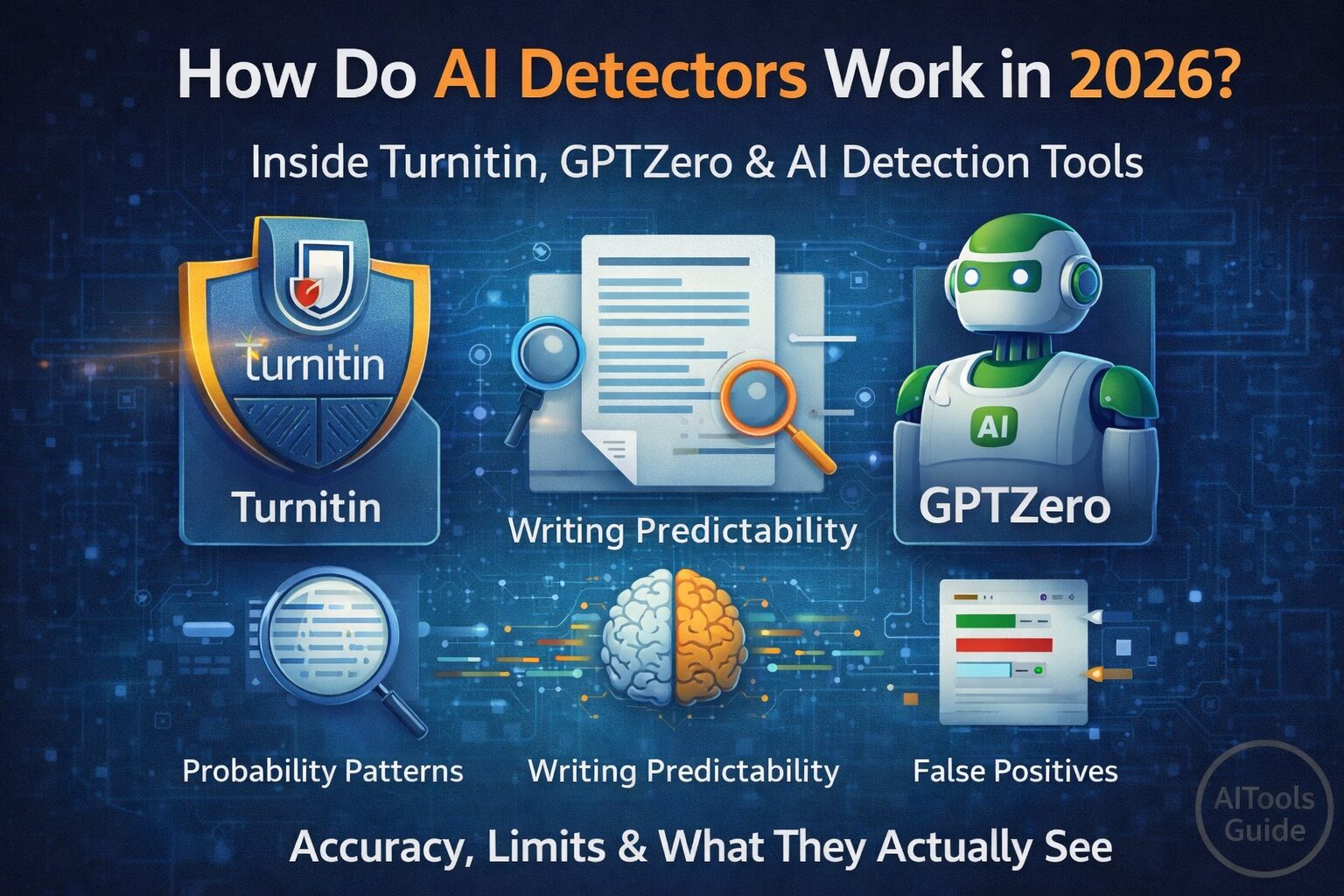
In 2026, AI detection tools like Turnitin, GPTZero, and other commercial platforms estimate the probability that a piece of text was generated by artificial intelligence. They do not look for a “ChatGPT signature.” They analyze statistical predictability, language structure, and writing behavior.
If you’ve ever wondered why AI-generated content sometimes gets flagged — or why human-written essays occasionally receive false positives — this guide explains exactly how AI detectors work behind the scenes.
Let’s break it down properly.
How AI Detectors Evaluate Text (Quick Overview)
| Signal Type | What It Measures | Why It Matters | Limitation |
|---|---|---|---|
| Perplexity | Word predictability | AI text often has lower randomness | Can flag formal academic tone |
| Burstiness | Variation in sentence length & structure | Human writing varies more naturally | Experienced writers may appear structured |
| Pattern Matching | Similarity to known AI-generated structures | Detects repeated AI-style phrasing | Edited AI text may distort signals |
| Probability Modeling | Statistical likelihood of AI-style output | Generates AI percentage scores | Not proof of authorship |
AI detectors estimate probability — they do not confirm authorship.
Table of Contents
What Is an AI Detector?
An AI detector is a tool that estimates whether text was likely written by a human or generated by artificial intelligence.
It does this by analyzing:
- Word probability patterns
- Sentence structure consistency
- Linguistic randomness
- Predictability of phrasing
These tools do not provide absolute proof. They give probability scores.
For example, a detector may say:
“72% likely AI-generated.”
That does not mean it is certain. It means the writing patterns statistically resemble AI output.
If you’re specifically wondering whether institutions like Turnitin can detect tools such as ChatGPT or QuillBot, we’ve covered that separately in our detailed guide on Can Turnitin Detect ChatGPT, QuillBot & Grammarly in 2026.
Here, we’re focusing on how detection actually works.
The Core Technology Behind AI Detection
AI detection systems rely mainly on statistical language modeling. The three most important concepts are perplexity, burstiness, and probability matching.
1️⃣ Perplexity Analysis
Perplexity measures how predictable a piece of text is.
AI models generate text by predicting the most statistically likely next word. Because of this, AI-generated writing often has lower randomness and higher predictability.
Human writing tends to be:
- Less uniform
- More irregular
- Slightly inconsistent in tone
AI writing tends to be:
- Smooth
- Evenly structured
- Grammatically consistent
If text is too statistically predictable, detectors may flag it.
This is why raw, unedited AI content is more likely to trigger detection.
2️⃣ Burstiness Measurement
Burstiness measures variation in sentence length and complexity.
Humans naturally vary their writing:
- Short sentences
- Long, complex ones
- Sudden tone shifts
AI tends to maintain more consistent rhythm and structure.
When writing lacks natural variation, detection scores may increase.
However, this is not a perfect signal. Experienced human writers can also produce consistent academic tone, which sometimes causes false positives.
3️⃣ Pattern Probability Matching
Some detectors compare writing patterns against massive datasets of AI-generated text.
If your text statistically resembles known AI output structures, the score increases.
This doesn’t mean detectors “know” which tool you used.
They evaluate similarity patterns.
Do AI Detectors Actually Work?
Short answer: Sometimes.
They work well when:
✔ Content is fully AI-generated
✔ Text is copied directly from ChatGPT without edits
✔ Writing is extremely formulaic
They struggle when:
✘ Text is heavily edited by humans
✘ Human + AI writing is mixed
✘ Content includes personal anecdotes or original ideas
If you’re specifically concerned about paraphrasing tools and detection risks, we tested that scenario in our detailed QuillBot vs Turnitin – AI Detection & Plagiarism Breakdown.
Detection accuracy drops significantly when human editing increases.
AI detectors are probability tools — not lie detectors.
⚠️ Limitations of AI Detection Tools in 2026
AI detectors are powerful — but they are not perfect.
Understanding their limitations is critical before trusting any AI score blindly.
1️⃣ False Positives Are Real
Non-native English writers often get flagged as “AI-like” because their writing patterns appear structured and predictable.
This does not mean the content is AI-generated.
2️⃣ Short Text Is Hard to Judge
AI detectors are less reliable on short paragraphs or short answers.
The longer the content, the more data the model has to analyze patterns.
3️⃣ Creative Writing Can Trigger Flags
Highly polished or grammatically consistent writing may appear “machine-like” — even if written by a human.
4️⃣ AI Models Evolve Faster Than Detectors
Language models improve constantly. Detection systems are always playing catch-up.
This means detection is based on probability, not certainty.
5️⃣ AI Score ≠ Academic Verdict
Universities do not rely on AI detection alone.
They review writing style consistency, drafts, citations, and context.
An AI percentage score is a signal — not a final judgment.
Key Insight:
AI detection systems provide probability estimates — not proof of authorship.
Institutional decisions are based on writing history, drafts, citations, and instructor review — not automated scores alone.
Why AI Detectors Sometimes Give False Positives
This is where things get complicated.
False positives happen when human writing gets flagged as AI-generated.
Common reasons include:
- Highly formal academic tone
- Non-native English writing patterns
- Extremely clean grammar and structure
- Technical or scientific writing
Academic essays often follow predictable structures:
- Introduction
- Thesis
- Body paragraphs
- Conclusion
This structure can resemble AI output.
That’s why some students receive unexpected AI flags even when writing manually.
This does not automatically mean misconduct. Institutions usually investigate further before making decisions.
If you’re dealing with an actual AI flag and unsure what to do next, read our detailed guide on what students should do after a false AI detection.
🔎 Popular AI Detectors Compared (2026 Overview)
Different tools use different detection approaches. Here’s a quick breakdown:
| Tool | Primary Use | AI Detection Focus | Who Uses It | Reliability Type |
|---|---|---|---|---|
| Turnitin | Academic institutions | Writing pattern + database comparison | Universities | Institutional-level |
| GPTZero | General AI detection | Probability & perplexity analysis | Students & educators | Pattern-based |
| Originality AI | Web & SEO content | Commercial AI detection model | Bloggers & agencies | Commercial tool |
| Copyleaks | Education & enterprise | Multi-model AI detection | Schools & businesses | Enterprise-level |
Important:
No AI detector can guarantee 100% accuracy.
All tools operate on statistical modeling and probability scoring.
If you’re evaluating which AI detection platform is most suitable for academic, commercial, or SEO use, see our in-depth comparison of the Best AI Detector Tools in 2026 for feature analysis, strengths, and limitations.
How Turnitin’s AI Detection Works
Turnitin’s AI detection system was designed primarily for academic institutions.
Key characteristics:
- Trained on academic writing datasets
- Focused on institutional submissions
- Integrated with plagiarism detection
Turnitin analyzes:
- Predictability
- Sentence uniformity
- Probability scoring
However, Turnitin does not publicly reveal its exact detection algorithm.
It provides AI probability indicators to instructors, not automatic penalties.
It’s important to understand instructors interpret results. The tool itself does not issue punishment.
How GPTZero & Commercial AI Detectors Work
GPTZero focuses heavily on perplexity and burstiness analysis.
Originality AI and similar commercial tools:
- Use probability modeling
- Provide percentage AI scores
- Often combine plagiarism detection with AI scoring
Free AI detectors are generally less reliable because:
- Smaller training datasets
- Simplified probability models
- Less academic calibration
If you are evaluating plagiarism tools alongside AI detection tools, you may also want to review our Best AI Plagiarism Checkers in 2026 guide for comparison clarity.
Detection and plagiarism are not the same thing.
Can AI Detection Scores Change After Editing?
AI detection scores can change after editing or restructuring content.
Heavy manual revisions, adding personal insight, or altering sentence structure may influence probability signals. However, this does not guarantee immunity from detection systems.
Detection tools rely on evolving statistical models — not fixed triggers. Attempting to “game” the system is unreliable long-term.
If you’re specifically wondering whether AI detection can truly be bypassed and what risks are involved, we explore that in detail in our guide on Can AI Detection Be Bypassed? (Myths, Risks & Reality in 2026).
Should Students Worry About AI Detection?
It depends on how AI is used.
High risk:
- Submitting fully AI-written essays
- Copying AI output directly
- Avoiding manual editing
Lower risk:
- Using AI for brainstorming
- Using AI for structure planning
- Editing AI drafts thoroughly
- Adding personal analysis
Safe academic workflow checklist:
✔ Use AI for outlining
✔ Rewrite in your own voice
✔ Add citations
✔ Verify sources
✔ Edit manually
AI should assist thinking — not replace it.
Understanding AI Detection Accuracy (Overview)
Accuracy varies significantly depending on content type, length, and editing level.
Most AI detection tools report probability-based estimates not guaranteed verdicts. Their performance tends to be stronger on fully AI-generated content and weaker when human editing is involved.
However, publicly available accuracy percentages are not standardized or independently verified across platforms.
👉For a data-driven analysis of reported AI detection accuracy rates, independent reliability discussions, and how percentage claims compare across platforms, read our full breakdown of AI Detection Accuracy Claims in 2026.
Final Verdict – Are AI Detectors Reliable?
AI detectors are statistical pattern-analysis tools — not lie detectors.
They are designed to estimate whether writing resembles AI-generated text based on probability signals, not to deliver definitive proof.
Most institutions treat AI scores as indicators that require human review, not automatic verdicts.
Understanding this distinction helps reduce unnecessary fear and confusion around AI detection.
At AI Tools Guide, we don’t hype tools — we test how AI actually works.
If you’re looking for practical tools to test your own writing, see our guide to the best free AI detector tools for students.
Frequently Asked Questions
Can AI detectors detect edited ChatGPT content?
Yes, but not reliably. Heavy editing reduces detection probability, but AI detectors analyze writing patterns, not just surface wording. Even rewritten content may still appear AI-generated if structure and tone remain consistent with machine output.
Can AI detectors be wrong?
Yes. Many students have reported false positives, where fully human-written essays were flagged as partially AI-generated. Detection systems rely on statistical patterns, not definitive proof.
Can Turnitin detect paraphrased AI content?
Sometimes. If paraphrasing only changes words but keeps the same structure and reasoning pattern, detection is still possible. Deep rewriting with original thinking significantly lowers detection probability.
Do AI detectors store your data?
It depends on the platform. Institutional tools like Turnitin store submissions in academic databases. Commercial AI detection tools vary — always review their privacy policies before uploading sensitive content.
How accurate are AI detectors in 2026?
AI detectors are not 100% accurate. They use probability models to estimate AI-generated writing, which can result in false positives (human text flagged) or false negatives (AI text missed), especially in formal academic writing.