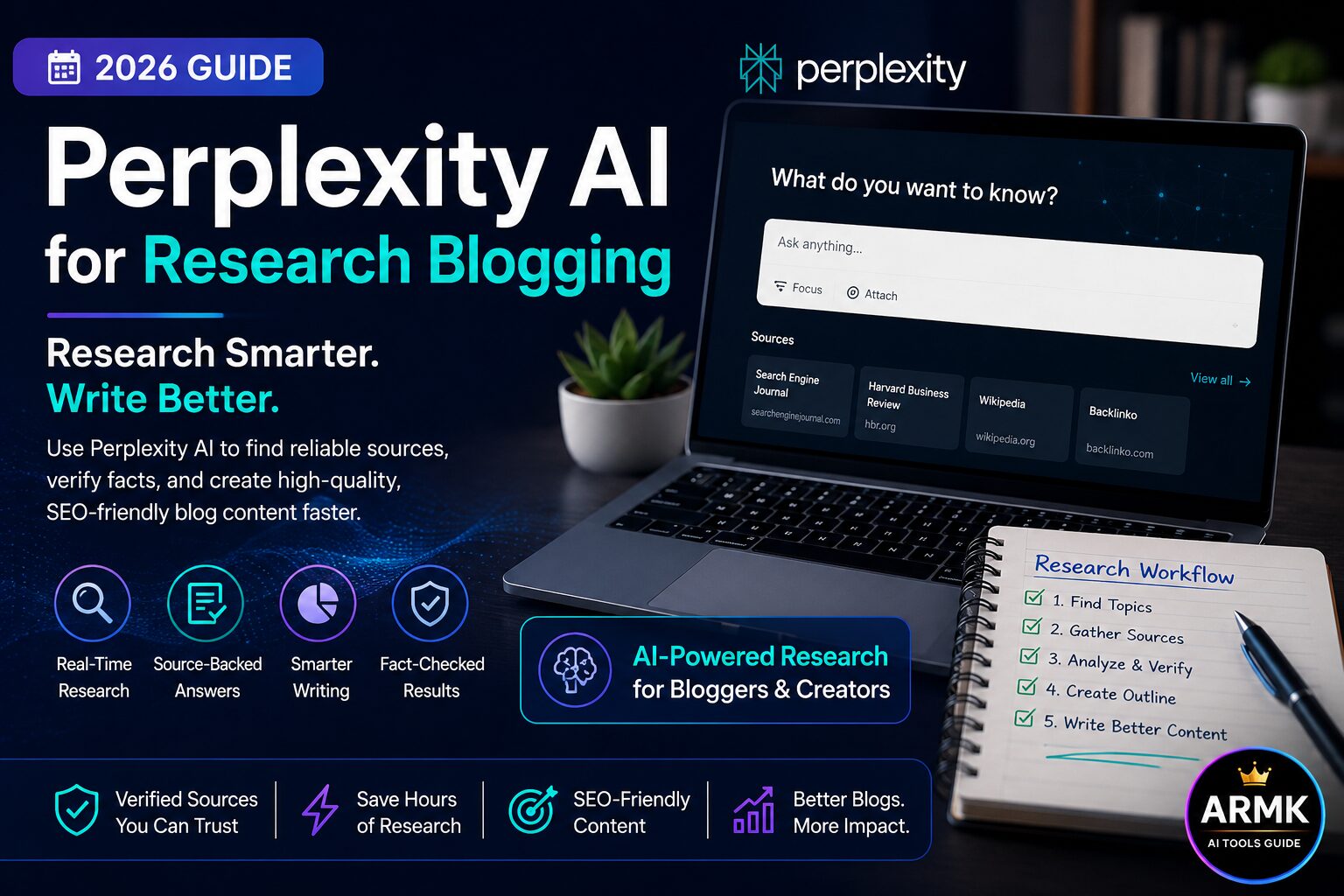
If you’ve ever spent hours switching between Google, AI chatbots, and dozens of browser tabs just to verify a single fact, you’re not alone. Finding accurate, up-to-date information is one of the biggest challenges in research and content creation today.
Perplexity AI is changing that by combining AI-powered answers with real-time web search and source citations, making research faster, more organized, and easier to verify. Whether you’re a blogger, student, researcher, or content creator, it can significantly improve the way you gather and validate information.
In this guide, you’ll learn how to use Perplexity AI for research blogging, how it compares with Google Search and ChatGPT, when it’s the better choice, and practical ways to integrate it into your research workflow for creating more accurate and high-quality content.
Table of Contents
What Is Perplexity AI?
Perplexity AI is an AI-powered answer engine that combines real-time web search with conversational AI to provide, source-backed answers in one place. Instead of making you search through multiple websites, it summarizes key information and provides citations so you can quickly verify the original sources.
Unlike traditional search engines that return a list of links or AI chatbots that may respond without references, Perplexity AI is designed to help you research faster, verify facts, and understand complex topics more efficiently. This makes it an excellent tool for bloggers, students, researchers, marketers, and professionals who need reliable information before creating content or making decisions.
🔍 Quick Highlights
- Real-Time Research: Find the latest information from across the web.
- Source-Backed Answers: Verify facts using linked references.
- Conversational Search: Ask follow-up questions without starting a new search.
- Faster Research Workflow: Spend less time searching and more time creating high-quality content.
🔍 Perplexity AI vs Google Search: Why Bloggers Are Exploring a New Research Workflow
Google Search remains one of the best tools for discovering websites, exploring different perspectives, and finding information across the web. However, researching a topic often requires opening multiple pages, comparing sources, and manually organizing information before you can start writing.
Perplexity AI takes a different approach. Instead of showing only a list of links, it combines real-time web search with AI-generated summaries and source citations, helping you understand a topic more quickly while making it easier to verify the original references.
For bloggers and content creators, this can significantly reduce the time spent gathering and organizing research. However, it doesn’t replace Google Search. Instead, the two tools work best together—Perplexity AI for faster research and synthesis, and Google Search for deeper exploration, discovering additional sources, and validating information when needed.
📊 Quick Comparison
| Google Search | Perplexity AI |
|---|---|
| Best for exploring the web and discovering diverse sources. | Best for quickly understanding a topic with summarized, cited answers. |
| Requires opening multiple websites for research. | Combines information into a single conversational response with references. |
| Excellent for broad searches, local results, shopping, and niche discoveries. | Excellent for research, learning, fact-checking, and content planning. |
| Gives you complete control over source selection. | Speeds up research while still allowing you to verify the cited sources. |
Recommendation: Use Perplexity AI to start your research and build a strong understanding of a topic, then use Google Search whenever you need deeper investigation, additional perspectives, or direct access to specific websites.
🚀 How Perplexity AI Helps in Research Blogging
Successful blogging isn’t just about writing—it starts with finding accurate information, understanding a topic, and organizing your research efficiently. This is where Perplexity AI can significantly improve your workflow.
Instead of spending hours searching through multiple websites, Perplexity AI helps you gather relevant information, compare different sources, and verify facts in one place. This allows you to spend less time researching and more time creating valuable content.
Here’s how bloggers can use Perplexity AI throughout the research process:
🔍 Research Topics Faster
Quickly understand a new topic by generating concise, source-backed summaries, making it easier to start writing without reading dozens of separate articles.
✅ Verify Facts Before Publishing
Use the provided citations to review the original sources and confirm important information before including it in your content.
📝 Build Better Content Outlines
Gather key points from multiple sources to create a logical article structure before you begin writing.
💡 Discover New Content Ideas
Explore related questions, trends, and follow-up topics to uncover fresh angles for future blog posts.
⏱️ Save Time Without Compromising Quality
By combining AI-generated summaries with source citations, Perplexity AI helps streamline research while still encouraging you to verify important information before publishing.
Pro Tip: Use Perplexity AI as your research assistant, not your final writer. Let it help you gather and organize information, then create original content in your own words after reviewing the cited sources.
🚀 How to Use Perplexity AI for Research Blogging (Step-by-Step Guide)
Whether you’re writing a blog post, researching a new topic, or planning SEO content, following a structured workflow will help you get more accurate and useful results from Perplexity AI.
Let’s make it simple 👇
Step 1: Start with a Clear Research Question
Go to perplexity.ai Sign in using Google or create a free account.
Then enter a specific question or topic instead of a broad keyword.
Example Prompt
Explain how AI search engines are changing SEO in 2026. Include recent trends, key statistics (if available), and cite reliable sources.
Why this matters
Specific prompts help Perplexity understand your goal and generate more focused, relevant answers.
Expected outcome
A well-structured overview with source-backed information that forms the foundation of your research.
Step 2: Review the Sources
Don’t rely only on the AI-generated summary.
Open the cited sources and verify important facts, statistics, and claims before using them in your article.
Why this matters
Source verification improves accuracy and helps prevent the spread of outdated or incorrect information.
Expected outcome
Reliable research that you can confidently reference in your writing.
Step 3: Explore Follow-Up Questions
Ask follow-up questions to understand the topic more deeply.
Examples:
- What are the latest updates?
- What are the limitations?
- How does this compare with ChatGPT?
- What mistakes should beginners avoid?
Why this matters
Follow-up questions uncover insights that are often missed in a single search.
Expected outcome
A deeper understanding of the topic and more original ideas for your article.
Step 4: Organize Your Research
Collect the most valuable insights and group them into logical sections before you start writing.
A simple structure might include:
- Introduction
- Key Concepts
- Benefits
- Limitations
- Best Practices
- FAQs
Why this matters
Organized research makes writing faster and helps create a more coherent article.
Expected outcome
A clear outline that is ready for drafting.
Step 5: Write Original Content
Use your research as a foundation, but write the article in your own words.
Avoid copying AI-generated responses directly. Add your own analysis, examples, and practical experience whenever possible.
Why this matters
Original content builds trust, provides unique value, and is more useful for readers.
Expected outcome
A well-researched article that reflects your own expertise rather than simply repeating AI-generated text.
🚀 Want Better AI Prompts?
Great research starts with great prompts. We’re continuously expanding the AI Tools Guide Prompt Library with practical prompt collections, research templates, blogging workflows, and other AI resources designed to help you get better results.
Bookmark AI Tools Guide and check back regularly for new prompt packs and workflow resources.
🤖 Perplexity AI vs ChatGPT for Research — Which Is Better?
Perplexity AI and ChatGPT are both powerful AI tools, but they are designed for different purposes. Choosing the right one depends on what you’re trying to accomplish.
Perplexity AI is primarily a research-focused answer engine. It combines AI-generated responses with real-time web search and source citations, making it well suited for finding, understanding, and verifying information.
ChatGPT, on the other hand, is a conversational AI assistant that excels at generating, rewriting, summarizing, brainstorming, and refining content. It is particularly useful once you’ve gathered the information you need.
📊 Quick Comparison
| Task | Perplexity AI | ChatGPT |
|---|---|---|
| Research current topics | ✅ Excellent | ⚠️ Depends on the model and available web capabilities |
| Source citations | ✅ Built-in references | ⚠️ Depends on search mode |
| Fact verification | ✅ Easy to verify using cited sources | ⚠️ Should be verified independently |
| Brainstorming ideas | ✅ Good | ✅ Excellent |
| Writing and rewriting | ✅ Helpful for outlines | ✅ Excellent |
| Editing and improving content | ⚠️ Basic | ✅ Excellent |
| Best Use Case | Research and information gathering | Content creation and refinement |
💡 Recommended Workflow
Instead of choosing one tool over the other, use them together for the best results:
- Research the topic with Perplexity AI to gather current information and reliable sources.
- Verify important facts using the cited references.
- Use ChatGPT to organize your ideas, improve readability, rewrite sections, or generate creative content based on your verified research.
- Review everything yourself before publishing to ensure accuracy and originality.
Recommendation: If your goal is to create high-quality blog content, start with Perplexity AI for research and finish with ChatGPT for writing and refinement. Using both tools together often produces better results than relying on either one alone.
🔍 AI Tools Guide Insight
Think of it this way:
- Perplexity AI answers: “What does reliable information say?”
- ChatGPT answers: “How can I turn that information into clear and engaging content?”
Understanding this difference helps you use each tool where it adds the most value.
Our conclusion should also become:
For current, source-backed research, Perplexity can be a strong starting point. ChatGPT can also search the web and is particularly useful for turning verified research into structured, readable content. The better choice depends on the task and workflow.
🎓 Perplexity AI for Academic Writing
Perplexity AI can be a valuable research assistant for students, educators, and researchers by helping them explore topics, understand complex concepts, and discover relevant sources more efficiently. However, it should be used to support the research process—not replace critical thinking or original writing.
Here are some practical ways to use Perplexity AI for academic work:
📖 Understand Complex Topics
Ask Perplexity AI to explain difficult concepts in simple language before exploring textbooks, research papers, or other academic sources.
🔍 Find Reliable References
Use the provided citations to identify relevant articles, reports, and websites that can support your research. Always review the original sources before using them in academic work.
📝 Organize Research Notes
Summarize key findings from multiple sources and organize them into clear notes to make writing and revision more efficient.
💡 Explore Different Perspectives
Use follow-up questions to understand various viewpoints, identify research gaps, or compare different approaches to a topic.
Responsible AI Tip: Perplexity AI can help you research and understand information, but your final academic work should reflect your own analysis, writing, and proper citations. Always follow your institution’s academic integrity and citation guidelines.
For thesis or scholarly work, use Perplexity to discover and explore sources, then verify the original papers and follow your institution’s citation and academic-integrity requirements.
📈 Perplexity AI for SEO Blogging
Creating SEO-friendly content starts with understanding what people are searching for and why. While Perplexity AI isn’t a dedicated SEO platform, it can be an excellent research assistant that helps you build more informative and user-focused content.
Here are some practical ways bloggers can use Perplexity AI during the SEO research process:
🔍 Understand Search Intent
Explore a topic from different perspectives to better understand what users are looking for before planning your content.
💡 Discover Content Ideas
Generate related questions, subtopics, and discussion points that can help you create more comprehensive articles.
📝 Build Better Content Outlines
Use your research to organize key sections, FAQs, and supporting information before you begin writing.
✅ Strengthen Content Accuracy
Review source-backed information and verify important facts to improve the quality and trustworthiness of your content.
SEO Tip: Perplexity AI works best as a research assistant, not a complete SEO tool. Use it to understand topics and gather reliable information, then combine it with dedicated SEO tools such as Google Search Console, Rank Math, Ahrefs, or Semrush for keyword research, performance tracking, and on-page optimization.
Perplexity AI Features for Bloggers
Perplexity AI includes several features that can simplify the research process. Instead of exploring every available capability, here are the features that provide the most value for bloggers and content creators.
🌐 Real-Time Web Search
Access up-to-date information from across the web, making it easier to research recent topics, trends, and industry updates.
Best for: News-based articles, technology updates, and rapidly changing topics.
📚 Source Citations
Every important claim should be verified before publishing. Perplexity AI provides source references, allowing you to review the original information instead of relying only on AI-generated summaries.
Best for: Fact-checking and improving content credibility.
💬 Conversational Research
Ask follow-up questions naturally to explore a topic in greater depth without starting a new search each time.
Best for: Understanding complex topics and expanding research.
📝 Research Summaries
Instead of reading multiple articles from beginning to end, Perplexity AI summarizes key information, helping you understand a topic more efficiently.
Best for: Building outlines and accelerating the research phase.
You can also use Research Mode Run deeper, multi-step research across many sources and generate a comprehensive report.
⚡ Faster Research Workflow
By combining search, summaries, and source references in one place, Perplexity AI helps reduce the time spent collecting information while keeping your research organized.
Best for: Bloggers who regularly publish detailed, well-researched content.
AI Tools Guide Tip: The most valuable feature isn’t any single capability—it’s the combination of real-time search, source citations, and conversational follow-up questions. Used together, these features can significantly improve both the speed and quality of your research.
❓ Frequently Asked Questions
1. What is Perplexity AI, and how does it help with research blogging?
Perplexity AI is an AI-powered answer engine that combines real-time web search with conversational AI to provide source-backed answers. For research blogging, it helps you gather information faster, explore different perspectives, and verify facts using cited references before creating original content.
Q2. Is Perplexity AI better than ChatGPT for research blogging?
It depends on your task. Perplexity AI is better for researching current topics and finding source-backed information, while ChatGPT is better for brainstorming, writing, rewriting, and improving content. Many bloggers achieve the best results by using Perplexity AI for research and ChatGPT for content creation and refinement.
Q3. How do I use Perplexity AI to research a blog post?
Start with a clear research question instead of a broad keyword. Review the AI-generated summary, open the cited sources to verify important information, ask follow-up questions to explore the topic further, organize your findings into an outline, and then write your article in your own words.
Q4. Is Perplexity AI free for research blogging?
Yes. Perplexity offers a free Standard plan with basic searches and limited access to advanced search features. Paid plans provide higher usage limits and additional capabilities for heavier research.
5. Can I use Perplexity AI for SEO blogging?
Yes, Perplexity AI can support SEO blogging by helping you understand search intent, discover related topics, generate content ideas, and build detailed outlines. However, it should complement—not replace—dedicated SEO tools used for keyword research, performance analysis, and on-page optimization.
6. How do I verify information from Perplexity AI before publishing?
Always review the original sources linked in the response, confirm important facts and statistics, check publication dates, and compare information across multiple reliable references when accuracy is critical. AI-generated summaries are useful for research, but important claims should always be verified before publication.
7. What are the most common mistakes when using Perplexity AI for blogging?
Common mistakes include publishing AI-generated content without verification, relying on a single source, copying AI summaries directly, overlooking publication dates, and skipping your own analysis. Use Perplexity AI as a research assistant, then create original content in your own voice after verifying the information.
8. How can I write better prompts for Perplexity AI?
Use clear, specific prompts that describe exactly what you need. Instead of asking a broad question, include your objective, preferred format, important details, and request source-backed information when appropriate. Better prompts usually produce more focused, useful, and reliable research results.
💡 Tip: Looking for more advanced prompts? Explore the growing AI Tools Guide Prompt Library for practical prompt collections, research templates, blogging workflows, and other AI resources designed to help you get better results.
📚 Continue Your AI Research Journey
If you found this guide helpful, these resources can help you build a complete AI-powered content creation workflow:
- ChatGPT for Content Creation – Learn how to turn your research into engaging content.
- Best AI Tools for SEO Blogging – Discover tools to improve content optimization and search performance.
- AI Research Workflow – Build a repeatable process for faste
- AI Prompt Guide – Write more effective prompts for research, writing, and productivity.
🎯 Final Thoughts
Perplexity AI can significantly improve your research process by combining AI-powered answers with source-backed information in one place. When used correctly, it helps you research faster, verify facts more efficiently, and build stronger, well-informed content.
However, the best results come from using Perplexity AI as a research assistant, not a replacement for your own expertise. Verify important information, add your own insights, and create original content that delivers genuine value to your readers.
If you’re ready to improve your AI-powered workflow, explore more practical guides, prompt libraries, and AI resources on AI Tools Guide.
The right AI tool can speed up your research, but your knowledge, judgment, and creativity are what turn research into valuable content.