PhD research is not just hard—it’s overwhelming.
- hundreds of papers
- complex concepts
- endless writing
And the biggest problem?
👉 Time vs depth trade-off
This is where AI tools can completely change how PhD students work—if used correctly.
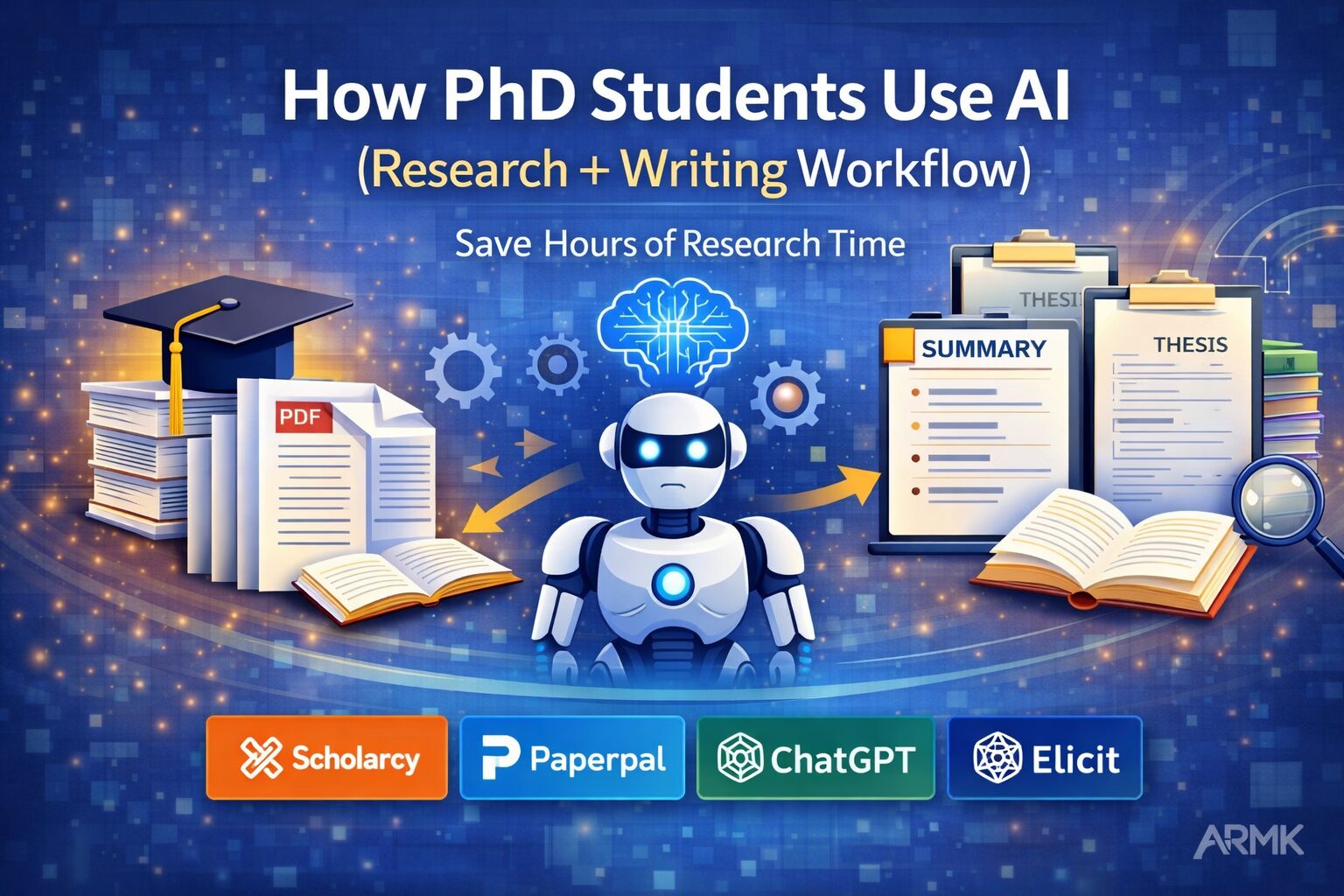
In this guide, you’ll learn how PhD students use AI for research, summarization, and writing, along with the best tools and workflows.
Table of Contents
🧠 Best AI Tools for PhD Students (Quick Overview)
If you’re looking for quick recommendations, here are some of the most useful AI tools for PhD students:
- Elicit → find and analyze research papers
- Scholarcy → break papers into key insights
- ChatGPT → flexible summarization & explanation
- Paperpal → academic writing assistance
- Scite → verify research credibility
👉 These tools will appear again in the workflow below.
🔬 The Real PhD Problem (That AI Solves)
Let’s be honest:
- reading papers takes hours
- extracting insights is slow
- writing becomes repetitive
👉 AI doesn’t remove effort
👉 It removes friction
⚙️ Step-by-Step AI Workflow for PhD Students
The actual system must be as follow
Step 1: Discover Relevant Research Papers
Use tools like Elicit to:
- find papers
- identify trends
- explore research gaps
👉 For deeper tools:
Best AI Tools for Literature Review
Step 2: Summarize Research Papers Quickly
Once you have papers:
- extract key findings
- simplify concepts
👉 Learn full method:
How to Summarize Research Papers Using AI
Step 3: Organize Insights & Notes
- group similar studies
- track important points
- build research structure
Step 4: Write Your Research Paper
Use AI to:
- draft sections
- improve clarity
- refine arguments
👉 Full guide:
How to Write a Research Paper Using AI
Step 5: Check Plagiarism & AI Detection
Before submission:
- ensure originality
- avoid false flags
👉 Learn more:
🧠 Best AI Workflow for PhD Students (Simple Model)
👉 Input → Papers
👉 Process → AI summarization
👉 Output → structured insights
👉 Final → writing + validation
Students can apply a simplified version of this workflow in ChatGPT exam preparation guide.
⚠️ Common Mistakes PhD Students Make with AI
This is where people mess up:
❌ blindly trusting AI
❌ skipping original papers
❌ overusing summaries
👉 AI is assistant—not researcher
Also avoid common AI mistakes by reading 7 mistakes students make using AI tools.
Final Thoughts 🚀
AI won’t replace PhD research.
But it will:
👉 make it faster
👉 make it structured
👉 make it manageable
At AI Tools Guide, we don’t hype tools — we test how AI actually works.
For PhD students, AI is not a shortcut—it’s a productivity multiplier.
❓ FAQs:
1. Can PhD students use AI tools for research safely?
Yes, but with caution. AI tools can assist in summarizing, analyzing, and organizing research, but you should always verify critical information from original sources.
2. What are the best AI tools for PhD students?
Some of the most useful tools include Elicit (research discovery), Scholarcy (summarization), ChatGPT (flexible explanations), and Paperpal (academic writing support).
3. Can AI replace PhD research work?
No. AI helps speed up tasks like summarization and writing, but deep understanding, critical thinking, and original contribution must come from the researcher.
4. Is it safe to use AI for thesis writing?
AI can assist in drafting and improving clarity, but relying entirely on AI-generated content may raise academic integrity concerns. Always edit and verify your work.
5. Do universities allow AI tools for PhD students?
Policies vary by institution. Some allow AI as a support tool, while others restrict its use in academic writing. Always check your university guidelines.