
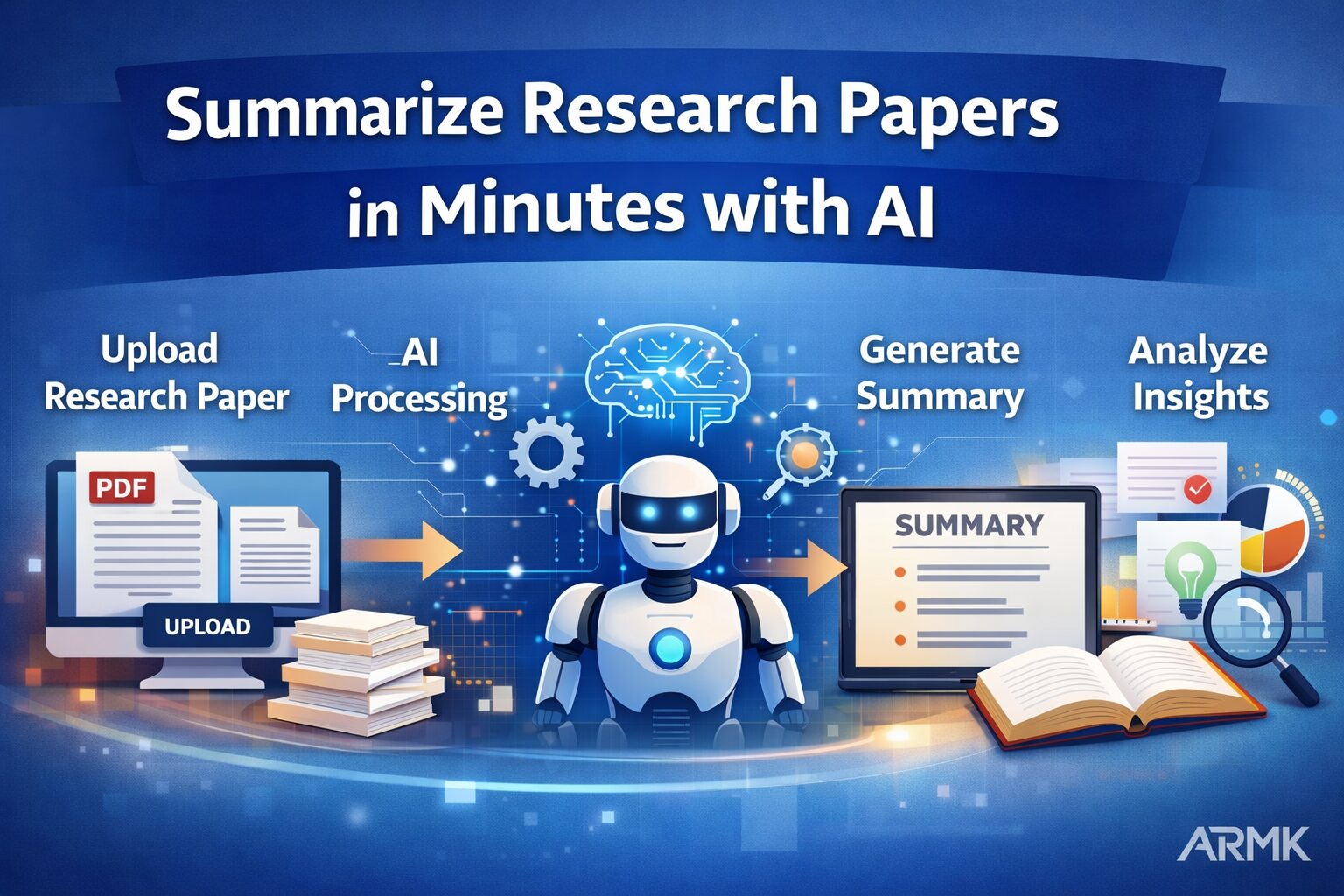
Research papers are powerful—but let’s be honest:
👉 They’re long
👉 Full of jargon
👉 And time-consuming to understand
This is where AI changes the game.
In this guide, you’ll learn how to summarize research papers using AI with a clear workflow, practical prompts, and real use cases—so you can save hours without losing important insights.
Below is a visual workflow showing how AI tools summarize research papers step by step.
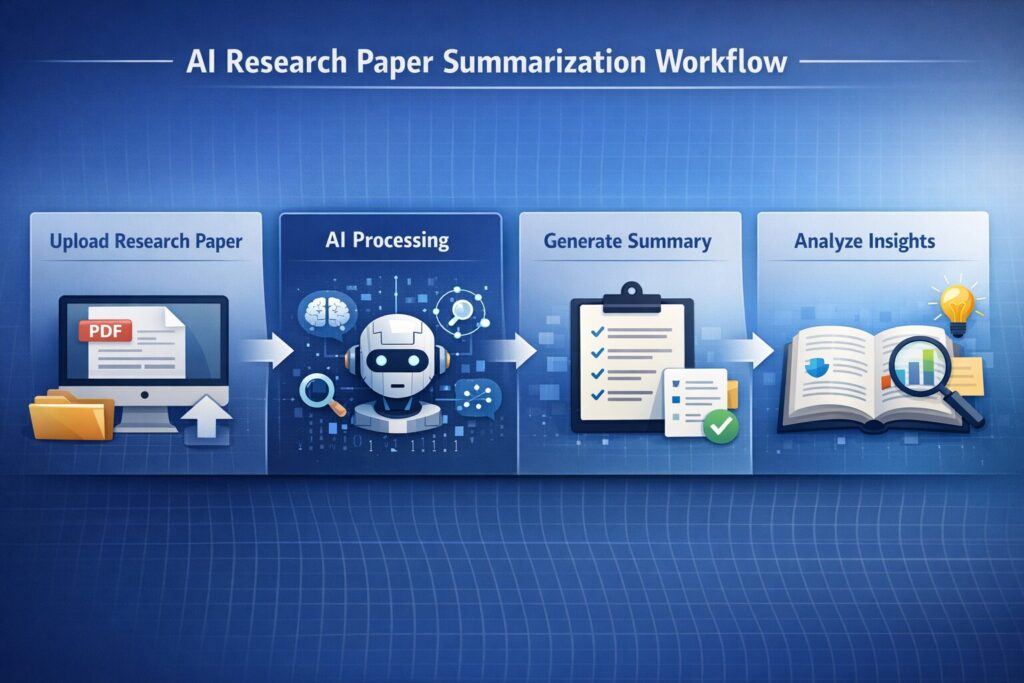
This workflow helps researchers quickly move from raw academic content to clear, actionable insights using AI.
Table of Contents
What Does It Mean to Summarize Research Papers Using AI? 🤖
Summarizing research papers using AI means using intelligent tools to:
- extract key findings
- simplify complex language
- identify main arguments
- highlight important sections
Instead of reading 20 pages, you can understand the core idea in minutes.
Why Use AI for Research Paper Summarization? ⚡
Here’s the real advantage—not hype:
1. Saves Massive Time
AI can scan and summarize papers in seconds.
2. Simplifies Complex Language
Turns academic jargon into easy-to-understand insights.
3. Improves Productivity
You can review more papers in less time.
4. Helps in Literature Review
Quickly identify relevant studies and discard unnecessary ones.
Manual vs AI: Research Paper Summarization Comparison 📊
| Factor | Manual Summarization | AI-Based Summarization |
|---|---|---|
| Time Required | 1–3 hours per paper | 1–5 minutes |
| Effort | High (deep reading required) | Low (automated processing) |
| Accuracy | High (if done carefully) | Medium–High (needs review) |
| Speed | Slow | Very Fast |
| Understanding | Deep but time-consuming | Quick but may need refinement |
| Scalability | Limited (few papers/day) | High (multiple papers quickly) |
👉 Insight (important, don’t skip):
AI doesn’t replace manual reading—it reduces the time needed to understand core ideas.
Step-by-Step: How to Summarize Research Papers Using AI 🧠
Here’s the actual system:
Step 1: Choose the Right AI Tool
Use tools that can:
- read PDFs
- understand academic context
- generate structured summaries
👉 Don’t overthink this step.
Focus on workflow first.
Step 2: Upload or Paste the Research Paper
- Upload PDF (preferred)
- Or paste abstract / sections
👉 Tip: Start with abstract + conclusion for faster summaries.
Step 3: Give a Clear Prompt (THIS CHANGES EVERYTHING)
Most people fail here.
Use prompts like:
Basic Prompt:
Summarize this research paper in simple language.
Better Prompt:
Summarize this research paper with key findings, methodology, and conclusion in bullet points.
Advanced Prompt:
Summarize this research paper in 5 bullet points. Highlight the problem, method, results, and limitations in simple language.
👉 Better prompt = better output
If you’re looking for tools that can generate better summaries based on these prompts, check our detailed guide on Best AI Tools for Summarizing Research Papers.
Step 4: Refine the Summary
AI is not perfect.
- remove irrelevant parts
- simplify further if needed
- verify key insights
👉 Never copy blindly.
Step 5: Extract Key Insights for Your Use
Now convert summary into:
- notes
- blog content
- assignments
- research references
Real Example: Before vs After Using AI 🧪
Let’s take a simple example.
📄 Original Research Text (Before)
“This study investigates the impact of artificial intelligence on academic productivity by analyzing various machine learning models and their ability to assist in literature review processes across multiple disciplines.”
🤖 AI Summary (After)
- AI improves academic productivity
- Helps in literature review across fields
- Uses machine learning models to analyze research
🧠 What You Should Notice
- Core meaning preserved ✔
- Complexity reduced ✔
- Time saved massively ✔
👉 But also:
- Some depth is lost ❗
- Always verify before using
Best Prompts to Summarize Research Papers Using AI ✍️
Save these. Actually use them.
📌 Prompt 1 (Quick Summary)
Summarize this paper in 3–5 key points in simple language.
📌 Prompt 2 (Student-Friendly)
Explain this research paper like I’m a beginner. Keep it simple and clear.
📌 Prompt 3 (Detailed Analysis)
Provide a structured summary including objective, methodology, results, and conclusion.
📌 Prompt 4 (Critical Thinking)
Summarize this paper and mention its strengths and limitations.
Common Mistakes to Avoid ⚠️
Let’s be real—this is where people mess up.
❌ 1. Blindly Trusting AI
AI can miss context or misinterpret data.
❌ 2. Using Weak Prompts
Bad input = bad output.
❌ 3. Ignoring Original Paper
Always cross-check important points.
❌ 4. Over-Relying on One Tool
Different tools give different outputs.
When Should You Use AI for Summarizing Papers? 📊
AI is best when:
- you’re doing literature review
- you need quick understanding
- you’re short on time
- you’re comparing multiple studies
👉 Not ideal for:
- deep critical analysis
- highly technical interpretation
If you’re working on a full literature review, you can also explore our complete guide on Best AI Tools for Literature Review to discover tools for research discovery, analysis, and summarization.
Final Thoughts 🚀
AI doesn’t replace research skills.
But it amplifies your efficiency.
If you use it correctly:
👉 You save time
👉 You understand faster
👉 You work smarter
Want to go deeper? Explore our curated list of AI tools for research and academic work to improve your workflow even further.
At AI Tools Guide, we don’t hype tools — we test how AI actually works.
If you’re a student or researcher, use AI as your assistant—not your shortcut.
FAQs
1. Can AI accurately summarize research papers?
Yes, but you should always verify important details.
2. Which AI is best for summarizing research papers?
It depends on your needs. Some tools are better for academic research, others for general summaries.
3. Is it safe to rely on AI for research work?
Use AI as a support tool, not a replacement for critical thinking.