Writing a research paper is one of the most challenging academic tasks for students.
You need to:
- find credible research papers
- analyze complex studies
- structure arguments logically
- maintain academic integrity
In 2026, many students are using AI tools to assist with parts of the research process.
But AI cannot replace critical thinking or original research.
Used properly, AI works best as a research assistant — helping you discover papers, summarize findings, structure ideas, and improve writing clarity.
This guide explains how to use AI tools safely and effectively when writing a research paper, without violating academic integrity.
What you’ll learn in this guide:
- how AI can help during different research stages
- the safest workflow for writing research papers with AI
- common mistakes students should avoid
- tools researchers actually use in academic workflows
No shortcuts. No hype. Just a practical academic workflow.
Table of Contents
Can You Use AI to Write a Research Paper?
Most universities now allow limited AI assistance in academic work.
Acceptable uses often include:
- brainstorming research topics
- summarizing research papers
- improving grammar and clarity
- organizing research notes
However, many institutions prohibit:
- submitting fully AI-generated research papers
- fabricating citations using AI
- copying AI summaries without verification
The safest approach is simple:
Use AI as a support tool, not a replacement for your own thinking.
If you want to explore specific platforms that help with literature review and academic research, see our detailed guide on AI Tools for Research Papers.
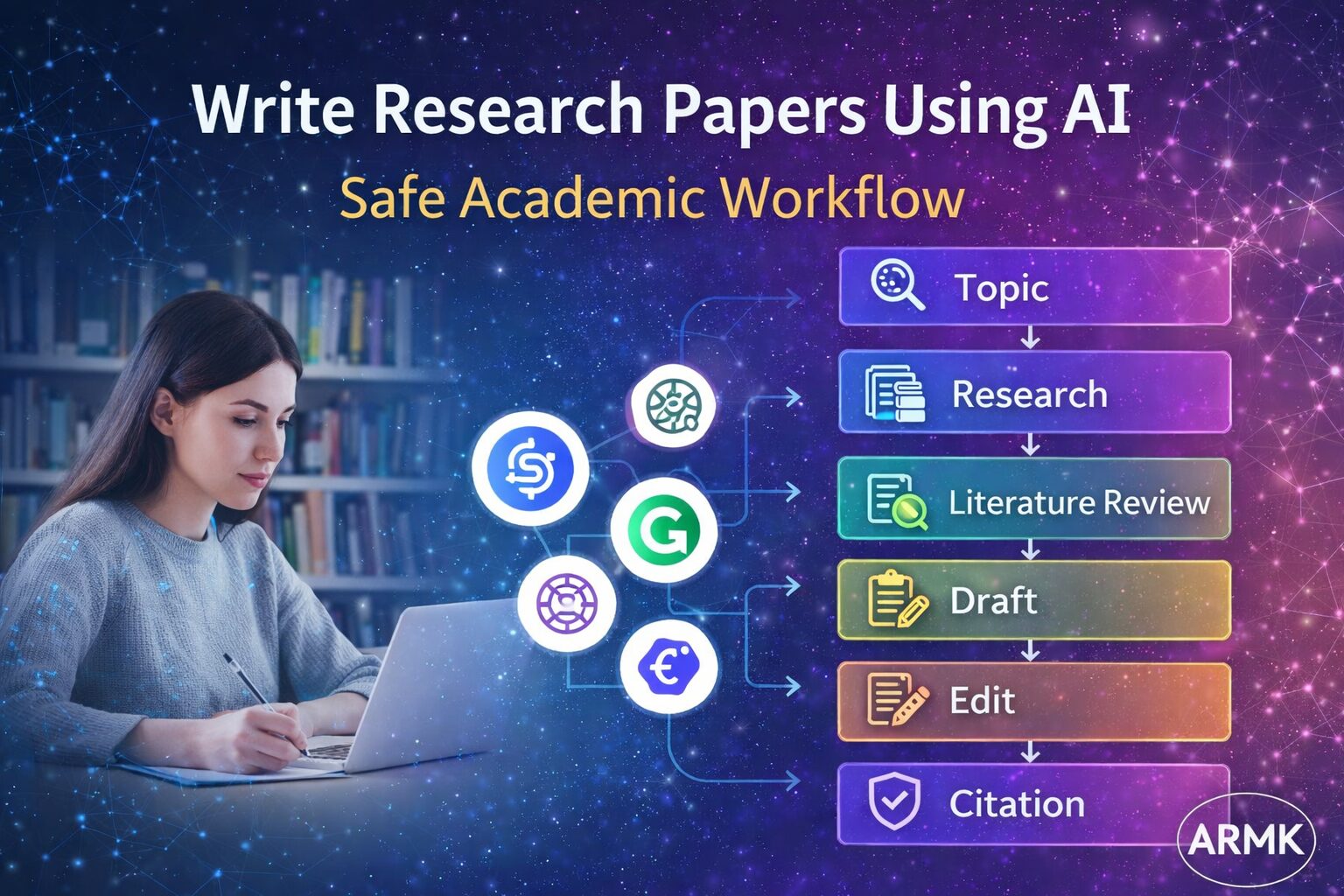
The Safe AI Workflow for Writing Research Papers
Most successful students follow a structured research workflow.
AI can assist in several stages of this process.
Research Topic
↓
Find Research Papers
↓
Literature Review
↓
Create Paper Outline
↓
Draft Writing
↓
Academic Editing
↓
Citation & Originality Check
Each step below explains how AI tools can help.
The key difference is that AI should assist your thinking, not replace it. We explain this balance in detail in our analysis of AI Writing Tools vs Human Writers.
Step 1: Choose a Research Topic Using AI
Choosing a strong research topic is often the hardest part of writing a paper.
AI tools can help generate topic ideas based on your academic field.
Tools commonly used:
- ChatGPT
- Perplexity
Example prompt:
“Suggest five research paper topics related to renewable energy adoption in developing countries.”
AI can help you brainstorm ideas and identify potential research angles.
However, your final topic should depend on:
- research relevance
- available academic sources
- your professor’s guidelines
AI suggestions should always be reviewed critically.
Step 2: Find Research Papers Using AI Tools
After selecting a topic, the next step is finding relevant research papers.
Traditional academic search can be slow, but some AI tools help accelerate discovery.
Useful AI research tools include:
Elicit
Elicit helps discover academic papers and extract key insights from research studies.
ResearchRabbit
ResearchRabbit visualizes citation networks and helps you find related research papers.
Consensus
Consensus answers scientific questions using peer-reviewed research papers.
These tools help you explore research faster, but you should still verify sources through trusted academic databases such as Google Scholar or university libraries.
Example Prompt (Research Discovery)
“Find peer-reviewed research papers about renewable energy adoption in developing countries and summarize the key findings.”
Practical Tip
When using AI research tools:
- prioritize peer-reviewed journals
- verify publication year
- read at least 2–3 original papers before summarizing
Step 3: Conduct a Literature Review Using AI
Literature review is where AI can save a lot of time.
Research papers often contain complex terminology and long technical explanations.
AI tools can summarize important parts of a paper.
Tools that help with this step:
- SciSpace
- Elicit
Example prompt:
“Summarize the key findings, research methodology, and limitations of this paper.”
Important tip:
Always compare AI summaries with the original research paper.
AI may simplify information, but verification ensures accuracy.
Step 4: Create a Research Paper Outline
Before writing the paper, build a clear structure.
AI can help organize your research into a logical outline.
Useful tools:
- ChatGPT
- Notion AI
Example prompt:
“Create a detailed research paper outline about the economic impact of renewable energy policies.”
Most academic research papers follow a structure like:
- Introduction
- Literature Review
- Methodology
- Results
- Discussion
- Conclusion
An outline helps ensure your arguments flow logically.
Step 5: Draft the Research Paper
AI writing tools can assist with drafting sections of your research paper.
However, generating the entire paper with AI is risky and often discouraged by universities.
Instead, use AI to support your writing process.
Recommended approach:
- write your core ideas yourself
- use AI to refine structure and clarity
Commonly used tools include:
- Grammarly
- ChatGPT
- Paperpal
These tools help improve readability without replacing your original research.
If you’re comparing AI writing assistants used by students, our detailed guide on Best AI Writing Tools for Students explains which tools actually improve academic writing.
Step 6: Edit and Improve Academic Tone
Editing is one of the most useful ways to use AI in academic writing.
AI editing tools can help:
- correct grammar
- improve sentence clarity
- refine academic tone
Popular tools include:
- Grammarly
- Wordvice
- QuillBot
These tools enhance writing quality while keeping your research ideas intact.
Step 7: Check Citations and Originality
Before submitting your research paper, it is important to verify:
- citation accuracy
- originality of the text
- potential plagiarism issues
Commonly used tools include:
- Copyleaks
- Turnitin
- QuillBot plagiarism checker
If you’re unsure how these systems differ, you can read our detailed explanation of AI Detector vs Plagiarism Checker.
Common Mistakes Students Make When Using AI
Many students misuse AI tools during research.
Common mistakes include:
- trusting AI-generated citations without verification
- copying AI summaries directly into a paper
- relying on AI instead of reading original research papers
AI tools should assist your research process, not replace it.
Academic integrity still depends on your own work and understanding.
Tools That Support the AI Research Workflow
Different AI tools assist different stages of the research process.
Instead of listing every tool here, we’ve covered the full breakdown in our guide:
👉 AI Tools for Research Papers
That guide explains:
- AI tools for literature review
- AI research discovery tools
- AI tools for summarizing papers
- AI tools for academic writing
Here we focus only on how to use AI during the research workflow.
Human Verification Checklist
Before submitting your research paper, review the following:
✔ Verify citations exist in the original research sources
✔ Compare AI summaries with the actual research paper
✔ Rewrite AI suggestions in your own academic voice
This ensures your research remains credible and original.
When You Should NOT Use AI in Academic Research
AI tools are helpful, but there are situations where relying on them can create problems.
Avoid using AI for:
- generating fake citations
- fabricating research results
- writing entire research papers without verification
Academic research requires original thinking and accurate sources.
AI should support the research process — not replace it.
FAQs
1. How can AI help during a literature review?
AI tools can summarize research papers, extract key findings, and identify relevant studies faster.
However, researchers should still read the original papers to verify accuracy.
2. Can AI generate research citations automatically?
Some AI tools suggest references, but they should always be verified using trusted databases like Google Scholar or academic journals.
3. Should students rely entirely on AI for research papers?
No. AI should assist with research discovery and editing, but critical analysis and final writing should remain the student’s responsibility.
Final Thoughts
AI tools are transforming how students approach academic research.
But the best research papers still depend on:
- critical thinking
- careful analysis of sources
- responsible use of technology
AI should support your research workflow, not replace it.
At AI Tools Guide, we don’t hype AI tools — we test how AI actually works.
If you’re a student navigating AI in academic research, understanding these tools responsibly is far more valuable than chasing shortcuts.