Short Answer
Students cannot directly access Turnitin without a university or institutional account.
Because of this, many students look for Turnitin alternatives to check plagiarism or AI-generated content before submitting assignments.
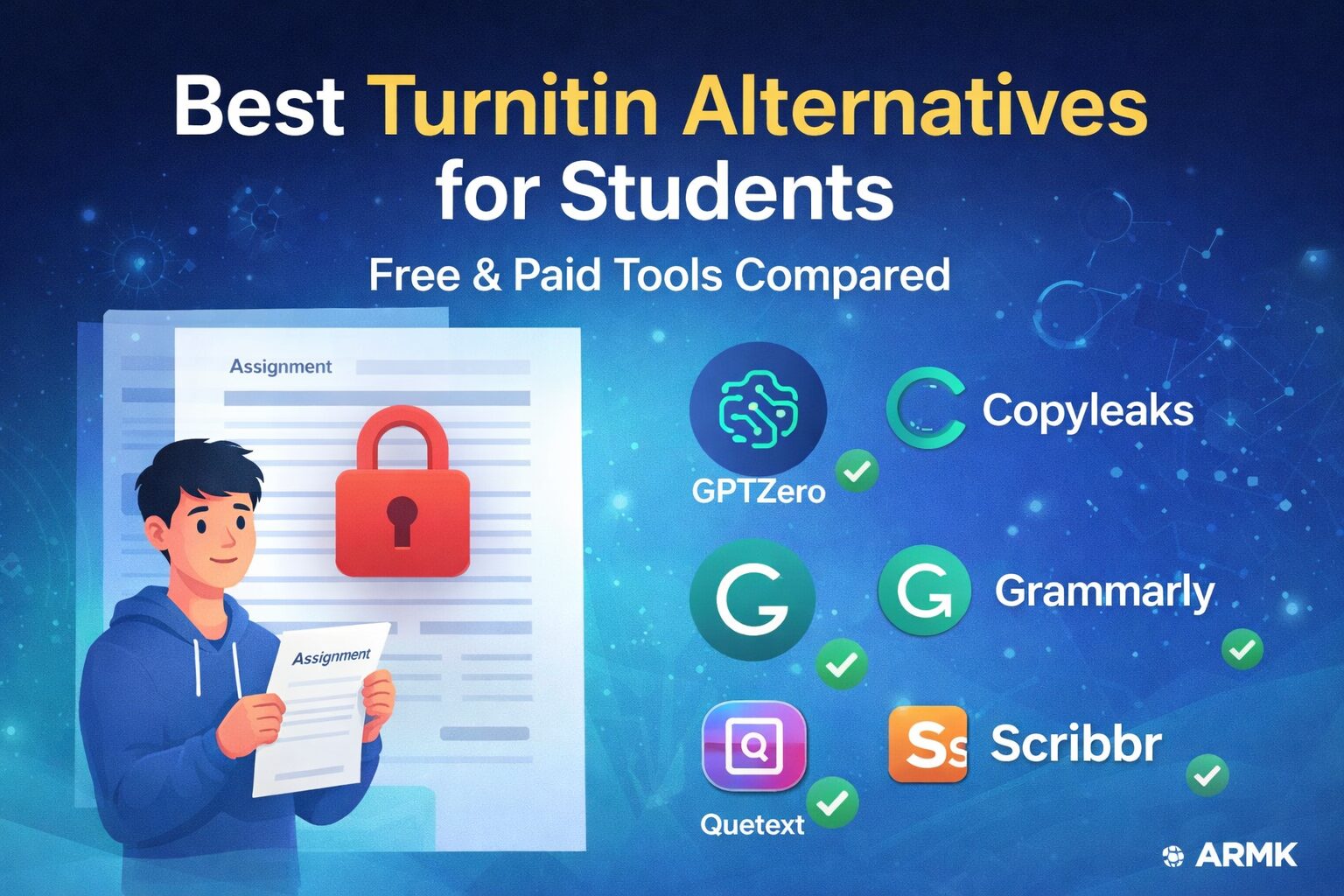
Several tools can provide similar functions, including:
- Copyleaks
- GPTZero
- Quetext
- Scribbr Plagiarism Checker
- Grammarly Plagiarism Checker
However, these tools are not identical to Turnitin, and each has different strengths.
This guide explains which alternatives students can realistically use and when they make sense.
Table of Contents
Why Students Look for Turnitin Alternatives
Turnitin is one of the most widely used academic integrity systems in universities.
It combines:
- plagiarism detection
- AI writing detection
- institutional submission workflows
- LMS integrations
But there is one important limitation:
Students cannot normally create their own Turnitin account.
Access is usually restricted to:
- universities
- schools
- instructors
- institutional administrators
Because of this restriction, students often search for:
- free Turnitin alternatives
- plagiarism checkers like Turnitin
- AI detection tools for essays
The goal is usually simple:
check assignments before submitting them.
What Makes Turnitin Difficult to Replace
Before looking at alternatives, it helps to understand why Turnitin is difficult to replicate.
Turnitin has access to:
- massive academic paper databases
- institutional submission archives
- journals and research publications
- private academic repositories
Most public plagiarism checkers do not have access to those databases.
This means alternatives can still be useful, but they may not detect all academic matches that Turnitin might identify.
Understanding this difference prevents unrealistic expectations.
Many students also confuse plagiarism detection with AI detection systems. If you’re unsure how these two technologies differ, see our detailed explanation of AI Detector vs Plagiarism Checker.
Best Turnitin Alternatives for Students
Below are some tools students commonly use when they cannot access Turnitin directly.
These tools vary in features, pricing, and reliability.
1. Copyleaks
Copyleaks is one of the closest public tools to Turnitin in terms of functionality.
It offers:
- plagiarism detection
- AI content detection
- API integrations for education platforms
Students often use Copyleaks to check whether writing appears AI-generated or copied from online sources.
Strengths:
- strong AI detection system
- academic use cases
- multiple language support
Limitations:
- advanced features require paid plans
- database coverage differs from Turnitin
If you want a deeper comparison between major AI detection tools, see our detailed analysis of GPTZero vs Copyleaks.
2. GPTZero
GPTZero is widely used for detecting AI-generated writing.
It was originally created to identify text produced by models like ChatGPT.
It analyzes:
- perplexity patterns
- sentence predictability
- structural variation
Students often use GPTZero when they want to estimate whether their writing might be flagged as AI-generated.
Strengths:
- focused AI detection
- easy to use
- free version available
Limitations:
- not a full plagiarism checker
- results are probability estimates
Some students also compare GPTZero with institutional detection systems. Our guide on GPTZero vs Turnitin explains the key differences.
3. Quetext
Quetext is a popular plagiarism checker used by students and writers.
It compares submitted text against web sources and online publications.
Key features include:
- deep search plagiarism detection
- citation assistance
- similarity reporting
Strengths:
- user-friendly interface
- affordable plans
- useful for essays and blog writing
Limitations:
- limited academic database access compared to Turnitin
4. Scribbr Plagiarism Checker
Scribbr is widely used by students writing research papers and theses.
It focuses heavily on academic writing support, including:
- plagiarism checking
- citation tools
- editing services
Strengths:
- strong academic focus
- helpful for research writing
Limitations:
- plagiarism checks are usually paid
- not designed as an AI detection system
5. Grammarly Plagiarism Checker
Grammarly includes plagiarism checking in its premium plan.
Students often use it alongside grammar correction tools.
Features include:
- grammar and style editing
- plagiarism detection
- writing suggestions
Strengths:
- integrated writing assistant
- useful during editing stages
Limitations:
- plagiarism database is smaller than Turnitin
- not designed for institutional submission workflows
6. Originality.ai
Best for: AI content detection.
Features:
- strong AI detection engine
- plagiarism detection
- detailed reports
Limitations:
- paid
- designed more for publishers than students
7. Winston AI
Best for: AI detection for essays.
Features:
- strong AI detection
- readability scoring
- document uploads
Limitations:
- limited free usage
Free vs Paid Turnitin Alternatives
Different tools offer different access levels.
Below is a simplified comparison of the 7 Turnitin alternatives covered in this guide.
| Tool | Free Plan | AI Detection | Plagiarism Check | Best For |
|---|---|---|---|---|
| Copyleaks | Limited | ✔ | ✔ | AI + plagiarism checks |
| GPTZero | ✔ | ✔ | ✖ | AI detection only |
| Quetext | Limited | ✖ | ✔ | Essay plagiarism checks |
| Scribbr | ✖ | ✖ | ✔ | Academic papers |
| Grammarly | ✖ | ✖ | ✔ | Writing improvement |
| Originality.ai | ✖ | ✔ | ✔ | Advanced AI detection |
| Winston AI | Limited | ✔ | ✖ | AI detection for essays |
Some advanced tools such as Originality.ai and Winston AI focus primarily on AI detection rather than full plagiarism scanning.
Each tool serves a slightly different purpose.
No single tool completely replaces Turnitin.
What Students Should Actually Use
Instead of searching for a perfect Turnitin replacement, students usually combine tools.
For example:
If the goal is plagiarism checking, tools like Quetext or Scribbr can help.
If the concern is AI detection, tools like GPTZero or Copyleaks may provide useful signals.
Many students check both:
- plagiarism similarity
- AI detection probability
before submitting assignments.
Can Free Tools Really Replace Turnitin?
Free tools can be useful, but they have limitations.
Most public tools cannot access:
- institutional paper archives
- private research databases
- university submission repositories
Because of this, results from free tools may differ from Turnitin reports.
However, they can still help students:
- identify obvious copying
- review similarity risks
- improve citation practices
They should be viewed as pre-submission checks, not exact Turnitin simulations.
Even if plagiarism similarity is low, AI-generated text may still be detected separately. We explain this difference in Can Plagiarism Checkers Detect ChatGPT.
When Should Students Use a Turnitin Alternative?
Students commonly use these tools in situations such as:
- checking essays before submission
- reviewing research papers
- verifying citations
- evaluating AI-generated drafts
Using plagiarism checkers early in the writing process can help avoid problems later.
But it is also important to understand that academic policies vary between institutions.
Some universities have strict rules regarding AI-generated content.
If you’re unsure how institutions evaluate AI writing, see Does Turnitin Detect ChatGPT?
Final Verdict
Turnitin is difficult to replace because it uses large academic databases and institutional submission systems.
However, students who cannot access Turnitin can still use several alternatives to check their writing.
Tools like Copyleaks, GPTZero, Quetext, Scribbr, and Grammarly offer useful features for plagiarism checking or AI detection.
While these tools are not identical to Turnitin, they can help students review assignments and improve academic integrity before submission.
FAQs
1. Is there a free version of Turnitin?
No. Turnitin is typically available only through schools or universities.
2. What is the closest alternative to Turnitin?
Copyleaks and Scribbr are often considered among the closest alternatives for plagiarism checking.
3. Can students use Turnitin themselves?
Usually, no. Access is provided through institutions.
4. Are Turnitin alternatives accurate?
They can identify plagiarism or AI patterns, but they do not have the same academic databases as Turnitin.