
Writing a research paper is one of the most demanding academic tasks.
Students and researchers must:
- find relevant research papers
- analyze complex studies
- conduct literature reviews
- write structured academic content
- maintain proper citations and originality
In 2026, many researchers are using AI tools for research papers to speed up these steps.
But there’s an important distinction:
AI should assist research, not replace it.
This guide explains:
- Which AI tools actually help academic research
- How students use AI tools for literature review and research summaries
- The safest workflow for writing research papers with AI
No hype. No shortcuts. Just practical tools researchers use.
Table of Contents
Why Students Are Using AI Tools for Research Papers
Academic research is becoming more complex every year.
Researchers face challenges like:
- growing publication volume
- tighter submission deadlines
- complex academic terminology
- literature review overload
AI tools help by assisting with:
- research discovery
- summarizing academic papers
- analyzing technical concepts
- improving writing clarity
Many students now rely on AI research assistant tools to explore academic literature more efficiently.
However, AI works best as a support system, not a replacement for reading original research.
How We Evaluated These AI Research Tools
To avoid biased recommendations, tools were evaluated based on:
- access to academic databases
- research discovery capabilities
- summarization accuracy
- citation reliability
- usefulness for academic workflows
The goal is not marketing claims — but real usability for research papers.
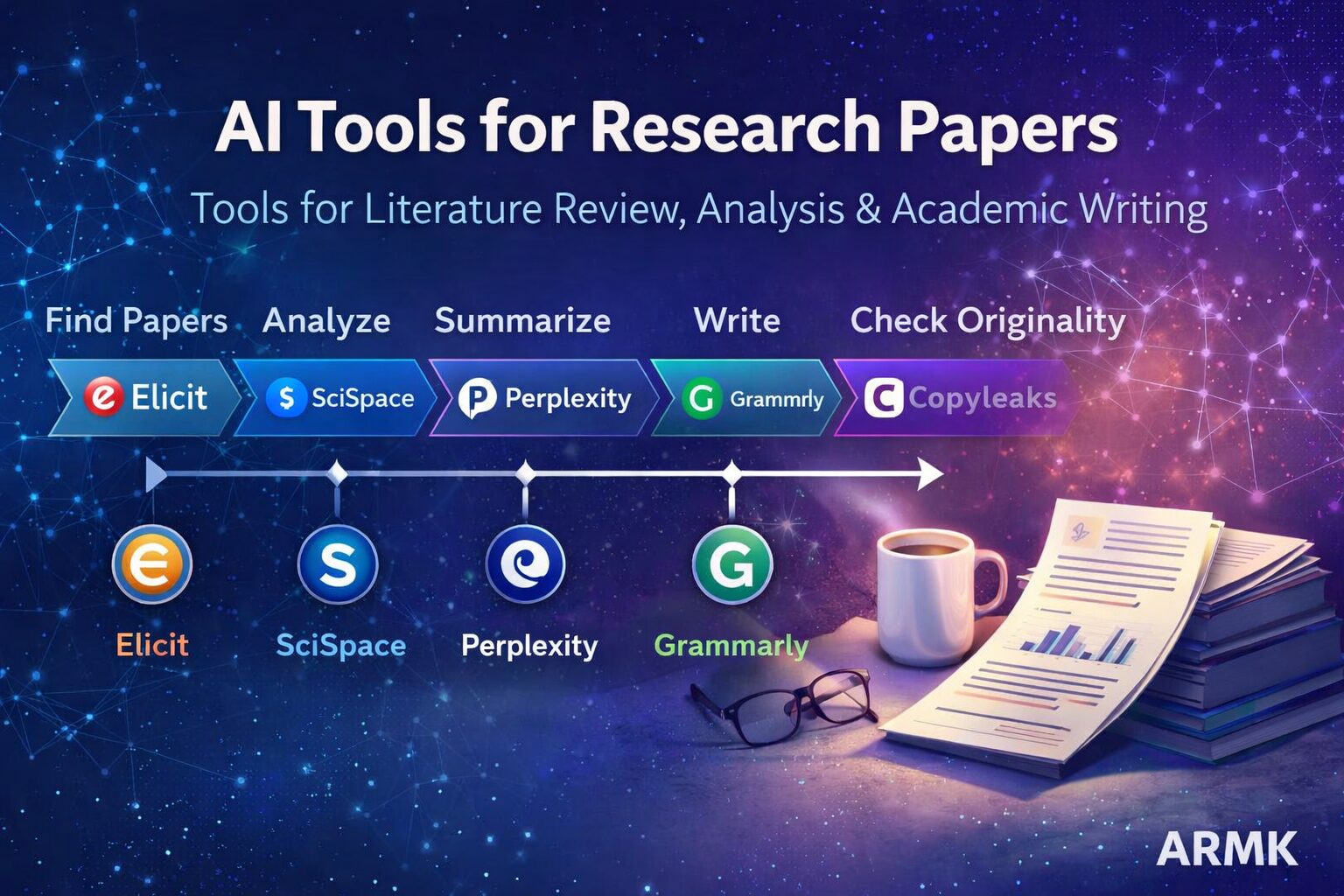
AI tools can support multiple stages of academic research — from discovering papers to editing the final manuscript.
However, tools alone are not the process.
If you want to see how these tools actually fit into a complete research paper workflow, read our step-by-step guide: How to Write a Research Paper Using AI.
AI Tools for Finding Research Papers
Finding relevant studies is often the hardest part of research.
These AI tools help students discover academic papers faster.
1️⃣ Elicit
Best for: literature discovery
Elicit helps researchers find academic papers by analyzing research questions.
Key advantages:
- semantic search across research databases
- extraction of study insights
- literature review assistance
Many students use Elicit as an AI tool for literature review and research discovery.
2️⃣ Consensus
Best for: scientific question answering
Consensus analyzes peer-reviewed studies and summarizes evidence.
Benefits:
- evidence-based answers
- direct links to academic sources
- research-backed summaries
This makes it useful for quickly understanding scientific research topics.
3️⃣ ResearchRabbit
Best for: discovering related research papers
ResearchRabbit maps relationships between academic papers.
Features:
- citation network exploration
- related paper discovery
- research tracking tools
Researchers often use it to find overlooked studies in a literature review.
AI Tools for Understanding Research Papers
Academic papers can be difficult to understand — especially technical research.
These tools help simplify complex studies.
1️⃣ SciSpace
Best for: explaining academic papers
SciSpace allows users to upload research papers and receive explanations.
Features:
- paragraph explanations
- technical concept breakdown
- research summaries
It’s widely used by students trying to analyze research papers more easily.
2️⃣ ChatGPT
Best for: simplifying academic concepts
ChatGPT helps researchers:
- summarize research papers
- explain difficult terminology
- generate structured outlines
Many students use it as an AI research assistant for understanding studies before writing literature reviews.
However, outputs should always be verified with original sources.
AI Tools for Literature Review
A literature review requires analyzing dozens of academic studies.
AI tools can help researchers summarize key insights quickly.
1️⃣ Elicit (Literature Review Mode)
Elicit can extract important findings from research papers.
Researchers use it to:
- compare study results
- extract research methods
- identify patterns in literature
This makes it one of the most effective AI tools for literature review.
2️⃣ Perplexity AI
Best for: research summaries
Perplexity generates answers with cited sources.
Advantages:
- research-based responses
- source citations
- faster topic exploration
It’s often used for research summaries before deeper reading.
AI Tools for Writing Research Papers
After reviewing literature, researchers must draft their papers.
These tools help improve clarity and structure.
1️⃣ Grammarly
Best for: academic editing
Grammarly helps improve:
- grammar
- sentence clarity
- academic tone
Many researchers use it to refine research paper drafts and thesis writing.
2️⃣ Notion AI
Best for: organizing research notes
Notion AI helps researchers:
- organize research notes
- summarize ideas
- structure writing outlines
This makes it useful for managing large academic writing projects.
If you’re exploring broader writing tools beyond research papers, see our guide on Best AI Writing Tools for Students, which compares tools for essays, assignments, and academic drafting.
AI Tools for Checking Originality and Citations
Academic research requires originality.
Researchers should verify that their work does not contain plagiarism or AI-generated issues.
Tools like:
- Copyleaks
- QuillBot plagiarism checker
- Turnitin alternatives
can help verify originality.
If you want to understand how AI detection systems differ from plagiarism checkers, see our guide on AI Detector vs Plagiarism Checker.
Free vs Paid AI Tools for Research Papers
| Research Stage | Best Free Tool | Best Paid Tool |
|---|---|---|
| Research discovery | Elicit | SciSpace |
| Literature review | Perplexity | Elicit Pro |
| Paper analysis | ChatGPT | SciSpace |
| Writing assistance | ChatGPT | Grammarly |
| Originality checks | QuillBot | Copyleaks |
Free tools can support research, but paid tools often provide deeper analysis features.
AI Tools for Literature Review vs Research Writing
Students often confuse these two tasks.
| Task | Best Tool |
|---|---|
| Literature discovery | Elicit |
| Paper explanation | SciSpace |
| Research Q&A | Consensus |
| Writing assistance | Grammarly |
| Editing & structure | Notion AI |
Understanding this difference helps researchers choose the right tool.
Common Mistakes Students Make When Using AI for Research
AI can assist research — but misuse can cause problems.
Common mistakes include:
- copying AI summaries directly
- trusting hallucinated citations
- skipping original research papers
- submitting AI-generated text as original work
Responsible use is essential for academic integrity.
If you’re concerned about whether AI-assisted writing might be flagged, you can review the most widely used systems in our guide to Best AI Detector Tools.
FAQs
1. Are AI tools allowed for research papers?
Most universities allow AI assistance for editing and research support, but not for generating original research content.
2. Can AI write a full research paper?
AI can help with outlines and summaries, but researchers must still write and verify the final paper.
3. What AI tool summarizes research papers?
Tools like SciSpace, ChatGPT, and Elicit are commonly used to summarize academic papers.
Conclusion
AI tools are transforming academic research.
Used responsibly, they can help researchers:
- discover relevant studies
- analyze complex research
- structure academic writing
But successful research still depends on critical thinking, original analysis, and proper citations.
AI should support the research process — not replace it.
In practice, researchers who use AI responsibly treat it as a productivity tool — not as a replacement for reading original studies or forming independent conclusions.