Most students use ChatGPT… but use it wrong.
They:
- ask vague questions
- copy answers blindly
- don’t use structured prompts
👉 Result? Weak learning.
But when used correctly, ChatGPT becomes a powerful study assistant.
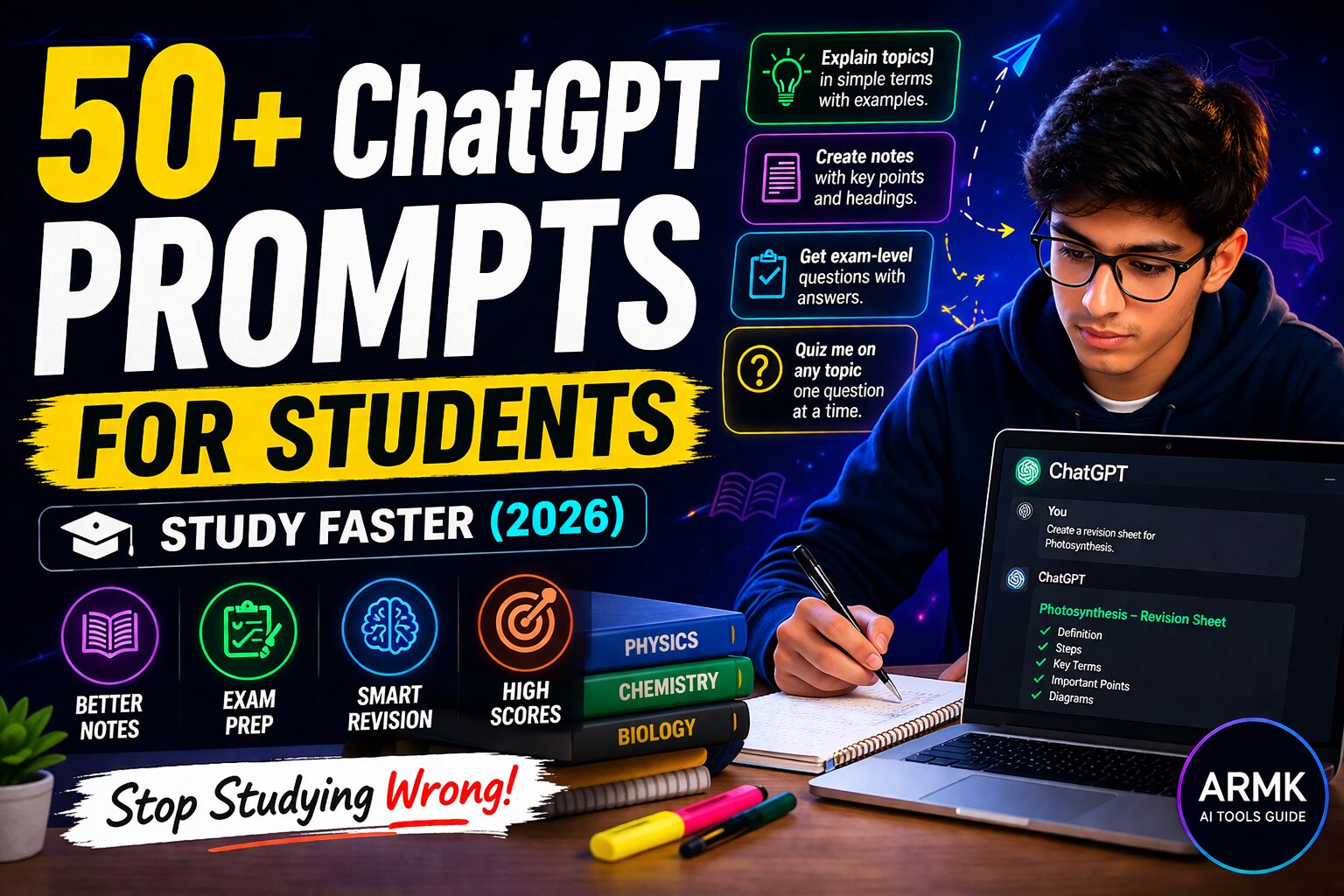
In this guide, you’ll get 50+ high-quality ChatGPT prompts designed for:
- understanding concepts
- making notes
- exam preparation
- revision & practice
Table of Contents
⚡ Quick Answer (For Fast Readers)
You can use ChatGPT prompts to:
- understand topics quickly
- generate structured notes
- practice exam questions
- revise using active recall
👉 The key is using specific prompts—not generic questions.
🧠 Why Prompts Matter More Than the Tool
ChatGPT is not the magic.
👉 Your prompt = the result.
Bad prompt:
Explain photosynthesis
Good prompt:
Explain photosynthesis in simple terms with examples, diagrams, and exam-focused points for a Class 12 student.
👉 Same tool. Completely different output.
⚙️ Best ChatGPT Prompts for Studying Concepts
Use these when learning new topics:
- Explain [topic] in simple terms like I’m a beginner
- Break down [topic] step-by-step with examples
- Teach me [topic] using real-life analogies
- Explain [topic] in a way I can remember for exams
- Compare [topic A] vs [topic B] with examples
👉 Best for: understanding + clarity
📝 ChatGPT Prompts for Notes Making
Turn long content into short notes:
- Create structured notes for [topic] with headings and key points
- Summarize this chapter into bullet points for revision
- Convert this paragraph into exam-ready notes
- Extract important points from this text
- Create short notes + examples for [topic]
👉 Best for: saving time + revision
🎯 ChatGPT Prompts for Exam Preparation
These are the most powerful:
- Generate 10 exam-level questions on [topic] with answers
- Create MCQs for [topic] with explanations
- Give previous-year style questions on [topic]
- Predict important questions for [subject]
- Create a test paper for [topic]
👉 Best for: practice + exam readiness
🔁 Prompts for Active Recall (REVISION HACK)
Most students ignore this—big mistake.
- Quiz me on [topic], ask one question at a time
- Test my understanding of [topic]
- Ask me questions without giving answers first
- Give me a rapid-fire revision quiz
- Check my answers and explain mistakes
👉 Best for: retention + memory
⚡ Last-Minute Revision Prompts
Use before exams:
- Summarize [topic] into a quick revision sheet
- Give key formulas and concepts for [topic]
- Create a cheat sheet for [subject]
- List most important exam points
- Give 5-minute revision notes
🔬 Real Example (Before vs After Prompt)
❌ Weak Prompt:
Explain photosynthesis
👉 Output: basic, generic
✅ Strong Prompt:
Explain photosynthesis in simple terms, include steps, key terms, and exam-focused summary for revision.
👉 Output:
- definition
- steps
- keywords
- summary
✔ faster learning
✔ better retention
📊 Study Without vs With ChatGPT Prompts
| Method | Result |
|---|---|
| Reading only | Slow + passive |
| Random ChatGPT use | Confusing |
| Structured prompts | Fast + effective |
⚠️ Common Mistakes Students Make
- ❌ using vague prompts
- ❌ copying answers blindly
- ❌ not verifying information
- ❌ over-dependence
👉 Read: 7 mistakes students make using AI tools
🔗 Related Guides
⚠️ Limitations of ChatGPT for Students
- may give incorrect info
- lacks deep subject accuracy
- cannot replace textbooks
👉 Always verify important answers.
🚀 Final Thoughts
ChatGPT is not just a chatbot.
It’s a study tool—if you know how to use it.
👉 Don’t just ask questions
👉 Ask better prompts
At AI Tools Guide, we don’t hype tools — we test how AI actually works.
For students, ChatGPT is not a shortcut—it’s a smart study system.
❓ FAQs
What are the best ChatGPT prompts for students?
Prompts that are specific, structured, and exam-focused work best.
Can ChatGPT help in studying?
Yes, it helps with understanding, notes, practice, and revision.
How to write better prompts?
Be clear, add context, and define output format.