Academic writing has never been easy — and in 2026, it’s more demanding than ever.
Students, researchers, and PhD scholars are under pressure to write clear, well-structured, plagiarism-free content, often in a second language, while meeting strict academic integrity rules. That’s why AI writing tools are increasingly used in academic research — not to cheat, but to work smarter.
This guide explains:
- Which AI writing tools are actually safe for academic research
- How to use AI ethically and responsibly
- What to avoid if you don’t want plagiarism or credibility issues
- Free vs paid tools — and who really needs what
No shortcuts. No fake promises. Just reality.
Table of Contents
Why AI Writing Tools Are Being Used in Academic Research in 2026
Academic researchers are not using AI because it’s trendy.
They’re using it because:
- Research volume has increased
- Publication standards are stricter
- English proficiency matters more than ever
- Deadlines are tighter
- Journals expect clarity, not excuses
AI writing tools help support academic work — especially in:
- Language correction
- Structural clarity
- Paraphrasing complex ideas
- Reducing repetitive editing work
But support ≠ replacement. That distinction matters.
Is It Ethical to Use AI Writing Tools for Academic Work?
Yes — if used correctly.
Most universities and journals do not ban AI assistance. What they prohibit is:
- Submitting AI-generated content as original research
- Fabricated citations
- Misrepresentation of authorship
Ethical use of AI in academics means:
- You remain the author
- AI helps with clarity, structure, or language
- All ideas and arguments are yours
- Citations are verified manually
Think of AI as a language and structure assistant, not a researcher or writer.
If you’re still confused about whether AI-assisted content can rank or be accepted, this breakdown on Can AI Writing Tools Rank Content in Google in 2026? explains the reality clearly.
What Academic Researchers SHOULD Use AI For (And What They Should NOT)
✅ Safe & Accepted Uses
- Improving grammar and academic tone
- Rewriting sentences for clarity
- Paraphrasing (with human verification)
- Creating outlines for papers or theses
- Explaining complex concepts in simpler language
❌ Risky or Unacceptable Uses
- Writing entire papers or dissertations
- Generating citations blindly
- Copy-pasting AI output without editing
- Replacing original analysis with AI text
AI should support your thinking, not replace it.
Best AI Writing Tools for Academic Research (Use-Case Based)
Academic research usually follows a structured process — finding papers, analyzing literature, drafting ideas, and verifying citations.
The tools below help researchers at different stages of this process.
If you want a complete step-by-step workflow showing how AI fits into the research paper process, see our guide: How to Write a Research Paper Using AI.
This list focuses on AI writing tools, not generic AI apps.
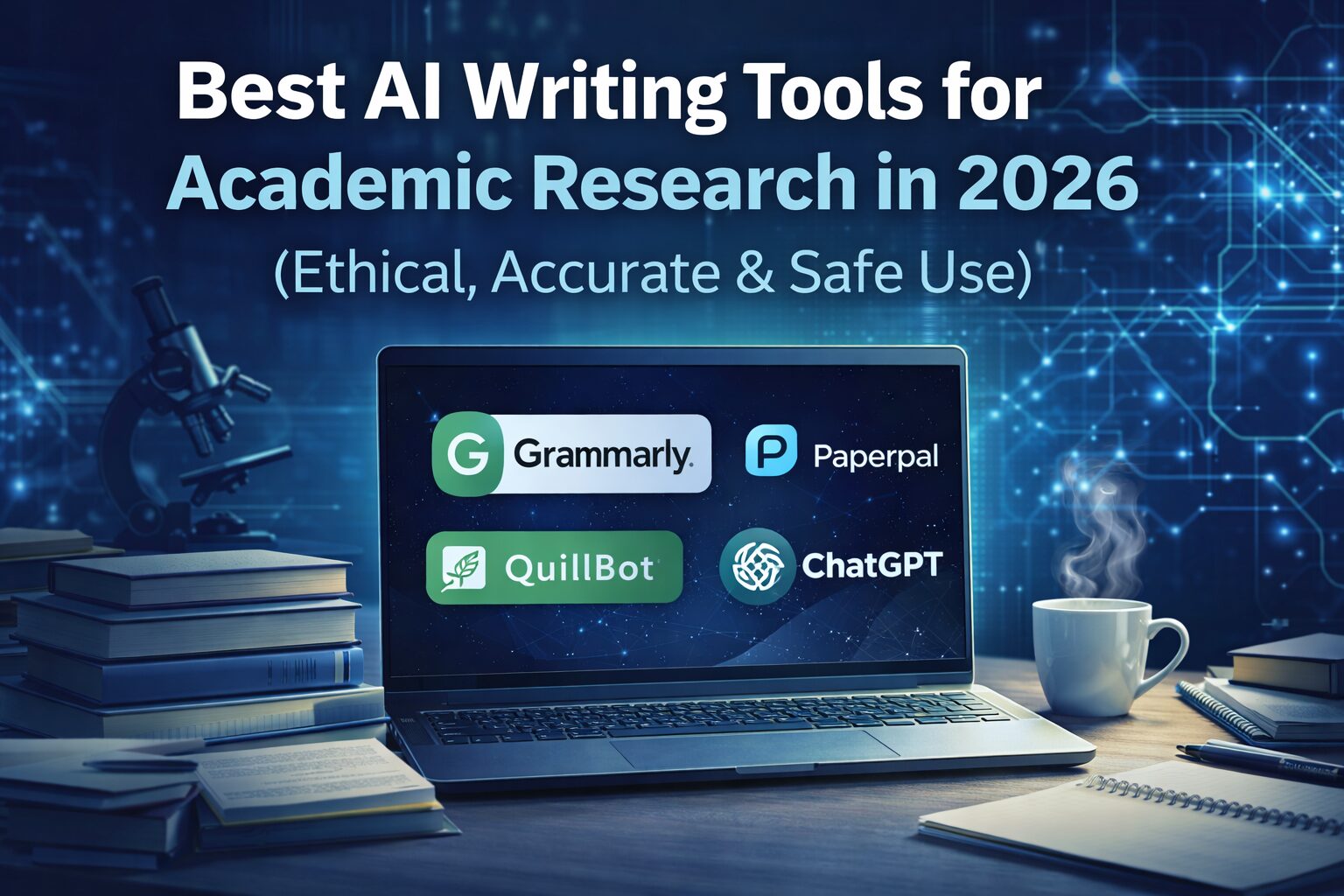
Grammarly (Free & Paid) — Grammar, Clarity & Tone
Best for:
- Academic grammar correction
- Sentence clarity
- Professional tone improvement
Why it works:
- Doesn’t generate content
- Improves what you write
- Safe for academic integrity
Paperpal — Academic-Focused Writing Assistant
Best for:
- Journal-style writing
- Research paper polishing
- Academic tone consistency
Why it stands out:
- Built specifically for academics
- Popular among researchers and publishers
- Safer than generic AI writers
QuillBot — Paraphrasing Academic Text
Best for:
- Rewriting dense paragraphs
- Avoiding repetition
- Improving readability
⚠ Use carefully:
- Always verify meaning
- Avoid over-paraphrasing
ChatGPT (Controlled Use)
Best for:
- Explaining concepts
- Creating outlines
- Brainstorming research directions
⚠ Do NOT:
- Submit AI-written paragraphs directly
- Trust citations without verification
Used properly, ChatGPT is a thinking assistant, not an author.
Many students also compare free vs paid tools before deciding, so this Free vs Paid AI Writing Tools (2026): What Actually Works guide can help you choose without wasting money.
Best Free AI Writing Tools for Academic Research (Students)
If you’re on a budget, this setup is enough:
- Grammarly (Free)
- QuillBot (Free)
- ChatGPT (Free version, careful use)
For most students, paid tools are optional, not mandatory.
Can AI Writing Tools Cause Plagiarism or AI Detection Issues?
Yes — if misused.
Problems arise when:
- AI text is copied directly
- Paraphrasing is excessive
- Human editing is skipped
Reality check:
- AI detectors are inconsistent
- Plagiarism risk comes from lazy usage, not AI itself
Safe rule:
If you can confidently explain and defend every sentence — you’re safe.
Common Mistakes Students Make Using AI Writing Tools
- Blind copy-paste
- Trusting AI citations
- Using AI to “sound smart”
- Replacing thinking with prompts
AI doesn’t fail students. Bad usage does.
AI Writing Tools vs Human Academic Writing (Reality Check)
| Aspect | AI Writing Tools | Human Academic Writing |
|---|---|---|
| Speed | Fast | Slow |
| Accuracy | Language-based | Idea-based |
| Originality | Limited | High |
| Authority | None | Human-led |
| Acceptance | Support role | Final authority |
AI assists. Humans decide.
FAQs
Q1. Are AI writing tools allowed in universities?
Most allow AI assistance — not AI authorship.
Q2. Which AI tool is best for academic papers?
Paperpal and Grammarly are safest.
Q3. Can AI help with thesis writing?
Yes — for structure and language, not original research.
Q4. Are free AI tools enough for students?
Yes, in most cases.
Final Verdict
In 2026, AI writing tools do not replace academic writers.
They help:
- Reduce friction
- Improve clarity
- Save time on editing
But:
- Humans think
- Humans analyze
- Humans take responsibility
Want more honest, research-safe AI guides like this?
At AI Tools Guide, we don’t hype tools — we test how AI actually works.
For students, researchers, and academics, our goal is simple: help you write clearer, work faster, and use AI responsibly — without risking credibility or integrity.